


|
|
The National Whistleblowers Center has advocated on behalf of many FBI whistleblowers, including FBI Counterterrorism Whistleblower Bassem Youssef. NWC is the main public interest organization supporting FBI agents who have exposed significant agency misconduct, including the illegal
FBI actions at Ruby Ridge, fraudulent science in the FBI crime lab, major breakdowns in the War on Terror and illegal retaliation against whistleblower agents. NWC’s efforts have resulted in systemic reform of the FBI crime lab, the introduction of Inspector General oversight of FBI misconduct, the removal and discipline of supervisors who retaliated against employees or engaged in misconduct, and ongoing Congressional review of the FBI’s wrongdoings. The NWC has also been invited to testify in Congress on the need to protect national security whistleblowers.
Although national security
employees were deprived protections under the Whistleblower Protection
Act of 1989, that does not mean they have no rights. In fact, all
federal employees, including national security employees, are required
under Executive Order 12731 to report waste, fraud, and abuse to the
proper authorities. The President has mandated employees report.
However, Congress has not lived up to its obligations to protect these
employees.
There are four critical cases that have determined
that all federal employees, including national security employees, are
protected under the First Amendment and cannot be retaliated against on
the basis of protected speech. These decisions are:
Pickering v. Board Of Education, 391 U.S. 563 (1968), which established First Amendment rights for federal employees.
Snepp V. United States, 444 U. S. 507 (1980), which recognized First
Amendment protection for national security employees in the context of
exposing wrongdoing.
Weaver v. USIA, 87 F3d 1429 (1996),
litigated by attorneys working with the NWC, determined that federal employees could file a
case in U.S. District Court to prevent 1st Amendment abuses.
Sanjour v. EPA, 786 F.Supp. 1033, 1036 (D.D.C.1992), also litigated by attorneys working with the NWC,
gave all federal employees the right to enjoin their agencies from
retaliation for 1st Amendment activities.
In addition, national
security whistleblowers have used the Privacy Act and the Freedom of
Information Act to obtain protections.
Finally, in the FBI as a
result of a successful five-year legal battle by Dr. Frederic
Whitehurst, President Clinton was forced to sign an Executive Order
requiring the attorney general to provide protections for FBI
whistleblowers. 64 Fed. Reg. 58782.
National security agencies
have traditionally tried to gag attorneys and employees from blowing
the whistle by forcing them to sign non-disclosure agreements. The NWC
has strongly and successfully opposed overly broad non-disclosure
agreements. The NWC has fought back by forcing agencies to follow the
obscure, but important, Appropriations Act of 2006 that prohibits such
agreements.
Lloyd -LaFollette Act, 5 U.S.C. § 7211, is another
law that provides protections for national security employees. Passed
in 1909, it was the first whistleblower law to protection federal
employees. This law prohibits retaliation against any federal employee
for providing information to Congress. The NWC has consistently
insisted on a whistleblower's right to appear before Congress. In
fact, the NWC had a major confrontation with the Department of Justice
(DOJ) in 2003 on this issue. The DOJ wanted to have "handlers" present
during a whistleblower's meeting with Congressional staff. The DOJ
eventually backed down and today whistleblowers can go to Congress without their supervisors knowing what they are reporting.
The Guardian (December 15, 2010) – Numerous US officials are calling for a resurrection of the US Espionage Act as a tool for prosecuting WikiLeaks. The dusting-off of the old law is all but certain. But the outcome of the constitutional dust-up that is sure to follow will result in triumph or tragedy for the US bill of rights.
In 1917, in the midst of a war hysteria, the United States passed the Espionage Act. The law has nothing to do with prosecuting spies. From its inception, it had everything to do with suppressing dissent. The Great War was unpopular with many Americans, very like today's engagements in Iraq and Afghanistan.
Sponsored by the National Whistleblowers Legal Defense & Education Fund
Lawyers & the Media: Strategies that Work and Pitfalls to Avoid in Whistleblower Cases
Whistleblowers who come forward to expose wrongdoing are critical sources for journalists. All attorneys who represent whistleblowers and journalists who use them as sources must understand the laws in place to protect whistleblowers when their story reaches the public. Attorneys also need to know how to effectively present their client's cases to journalists. This seminar will cover the 1st amendment protections that attorneys need to know to protect their clients, and journalists need to protect whistleblower sources.
...
|
|
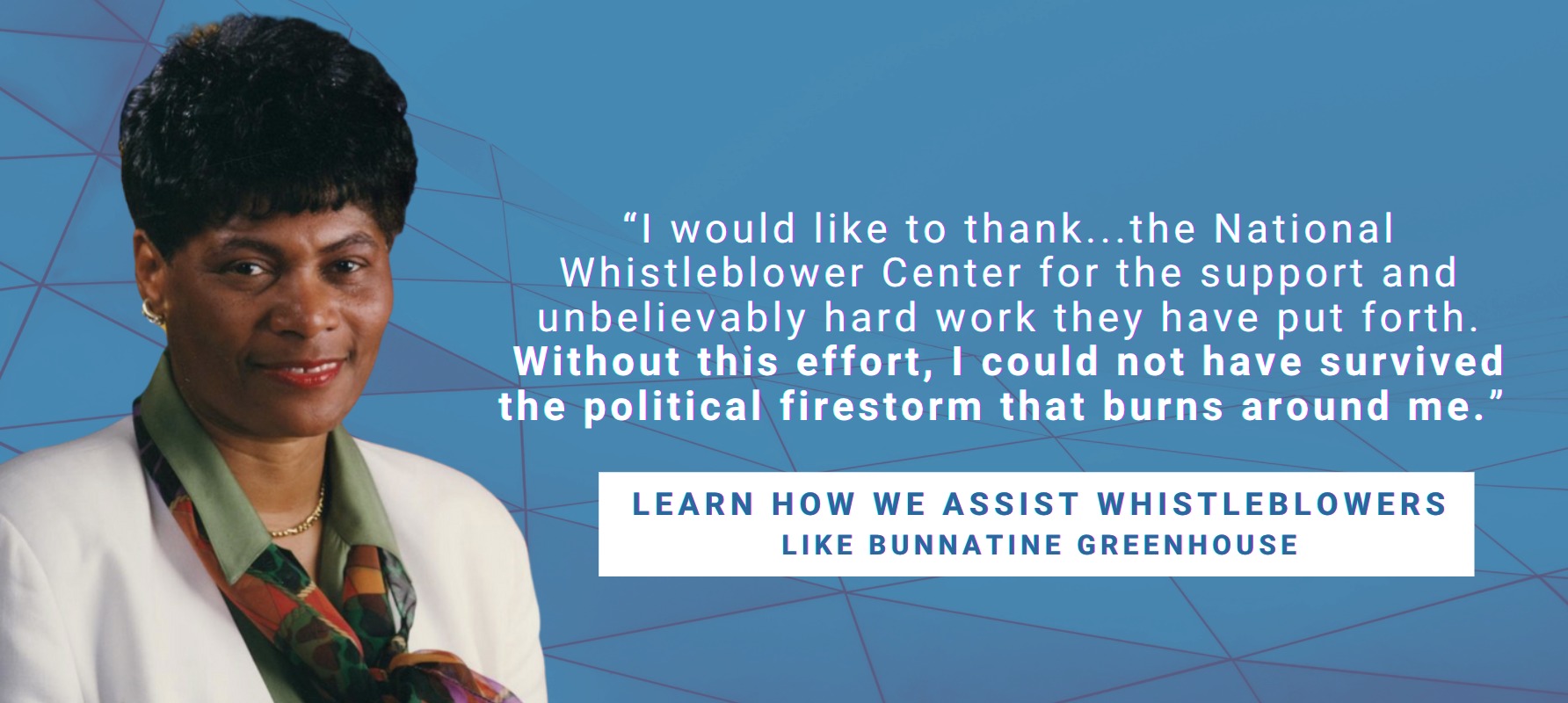
Washington, D.C. September 3, 2009. As reported in a front page story of today's Washington Times, internationally respected whistleblower, Bunnatine Greenhouse, has issued an appeal to the U.S. Senate to pass strong protections for all federal employees. Mrs. Greenhouse was the only major Bush Administration executive to challenge the Halliburton "no bid" Iraq reconstruction contracts. In 2005, Mrs. Greenhouse was featured in a Washington Post Style section article A Web of Truth: Whistle-Blower or Troublemaker, Bunny Greenhouse Isn't Backing Down and also on NOW: Politics & Economy Bunny Greenhouse.
"We urge every American to read Bunny's letter and to TAKE ACTION! ," said Stephen M. Kohn, NWC Executive Director. "This is not a Democrat or Republican issue. This is not a partisian issue. This is an issue that goes to the heart of accountability and oversight. In the House of Representatives Democratic leader Chris Van Hollen (D-MD) joined with his republican colleague Todd Platts (R-PA) to introduce an effective whistleblower law that would give Bunny Greenhouse her day in court , The Senate should follow this bi-partisian lead and ensure that the promises made to whistleblowers during the 2008 election campaign are fulfilled."
NWC Press Release: Greenhouse's Most Recent Letter Causes A Stir
Read a 12-part series on the Whistleblower Protection Blog analyzing the Senate Whistleblower Bill.
The National Whistleblowers Center created this special page with links to the extensive sworn testimony and documentary evidence concerning the FBI's actual response to the attacks of September 11, 2001. Included are the sworn depositions of every major FBI manager responsible for the creation the FBI's post September 11th counterterrorism division and the implementation of the FBI's "War on Terror," including the sworn depositions of FBI Director Robert Mueller, former FBI Director Louis Freeh, and the major managers responsible for running the FBI's counterterrorism program from the year prior to the attacks through 2006. More
S. 372 repeals existing FBI protections and expands state secrets privilege
Washington, D.C. March 10, 2010. Prominent national security whistleblowers and advocacy groups issued a letter today urging the Senate to vote against the Whistleblower Protection Enhancement Act of 2009 (S. 372) unless the dangerous national security whistleblower provisions are corrected. This bill, which is currently being “hotlined” for unanimous consent, repeals existing FBI protections and strengthens the state secrets privilege.
The letter, signed by national security whistleblowers and respected advocates for national security employees, explains in detail the deficiencies in the Senate bill that will harm national security by covering up intelligence failures and civil liberties abuses:
|
TAKE ACTION! |
FBI Whistleblower Urges Strong Corrective Action
Washington, D.C. January 20, 2010. Today the Department of Justice Office of the Inspector General released a report that confirms the allegations regarding an illegal FBI domestic surveillance program, which were reported on the front page of the Washington Post yesterday, January 19, 2010.
Attorneys for Bassem Youssef , the highly decorated Chief of the FBI's Communications Analysis Unit in the Counterterrorism Division, are requesting that Attorney General Eric Holder take strong corrective action to ensure that civil liberties are protected and that the FBI properly conduct counterterrorism investigations. According to a letter sent today by Mr. Stephen Kohn, the Executive Director of the National Whistleblower Center and one of Mr. Youssef's attorneys:
Washington, DC. January 19, 2010. In response to the front-page article appearing today in the Washington Post, the following statements were released by Stephen M. Kohn, attorney for Mr. Bassem Youssef (Chief of the FBI’s Communications Analysis Unit/Counterterrorism Division) and National Whistleblowers Center Executive Director:
“Since 2005, when he first learned of the abuses reported in today’s Washington Post, Mr. Youssef has attempted to ensure that the FBI complied with the law. Between 2006-08 he provided extensive testimony before the DOJ Office of Inspector General. In 2008 and 2009, his counsel provided three detailed letters to the Attorney General of the United States setting forth details on the misconduct committed within the FBI and urging that effective corrective actions be taken."
TAKE ACTION! Demand Congress protect all national security whistleblowers!