

| Policy Paper - Roadmap For Change |
December 12, 2008
I. PURPOSE
On May 8, 2007, President-Elect Barack Obama confirmed his strong
support for enhancing whistleblower protections in the United States.
He responded to a survey conducted by the National Whistleblowers
Center (NWC),1 and was the first candidate for president to commit, in writing, to endorsing the six major policy positions of the NWC.2 President-Elect Obama specifically endorsed the following principles:
-
"Support protecting whistleblowers under the framework of H.R. 985"
-
"Advocate for the passage of a law which would give employees who are illegally terminated for blowing the whistle the same procedural and substantive protections as other wrongfully discharged employees under laws such as Title VII of the Civil Rights Act of 1964"
-
Ensure that the "people appointed as the Special Counsel have expertise in whistleblower law and a firm commitment to protecting whistleblowers"
-
"Employees who expose weaknesses in Homeland Security and/or the government's efforts to combat terrorism" should be "fully protected under the whistleblower laws"
-
"Ensure that the statute of limitations applicable to environmental whistleblowers is enlarged to 180 days"
-
"Appoint a liaison responsible for interacting with whistleblower advocates in order to better ensure that no employer illegally retaliates against employees who expose violations of law or waste, fraud and abuse"
President-Elect Obama's commitment to whistleblower protections was
also reflected in his formal policy statements and in speeches on the
campaign trail. For example, President-Elect Obama's Web site states,
"We need to empower federal employees as watchdogs of wrong doing and
partners in performance. Barack Obama will strengthen whistleblower
laws to protect federal workers who expose waste, fraud, and abuse of
authority in government. Obama will ensure that federal agencies
expedite the process for reviewing whistleblower claims and
whistleblowers have full access to courts and due process." 3
The purpose of the policy paper is to set forth guidance for the new
administration and Congress on what specific steps need to be taken to
ensure that the promise to adequately protect employee whistleblowers
is fulfilled by the federal government.
II. THE NEED
A. Corporations Have Recognized the Need to Encourage and Protect Whistleblowers
Responsible corporate organizations have carefully studied
whistleblowing around the world and have strongly endorsed increased
whistleblower protections. In 2007, PricewaterhouseCoopers, one of the
world's highly respected corporate auditing firms, conducted a
comprehensive international study to discover the "root causes of
economic crime and the ways in which it affects businesses worldwide."4
The study was conducted by surveying the chief executive officers,
chief financial officers and other responsible executives from over
5,400 companies in 40 countries. This comprehensive and objective
survey issued the following findings:
-
"Fraud remains one of the most problematic issues for business worldwide" but in order to detect and combat fraud, corporations "cannot" simply "rely on" internal "controls" to "detect and deter economic crimes."
-
"Despite the attention of regulators and companies' investment in controls, the actual level of economic crime and the associated financial and non-financial damages have not decreased - one out of every two companies fell victim to economic crime in the last two years."
-
"[I]n virtually every region of the world whistle-blowing is playing a role in uncovering the activities of wrongdoers. More and more companies are now promoting whistle-blowing policies as an integral part of their risk management programmes."
One of the conclusions of the PricewaterhouseCoopers study was the following:
We believe whistle-blowing systems that are both well designed and
properly implemented can play a decisive role in uncovering criminal
activity. This is reflected in our respondents' very positive views on
their own whistle-blowing system's effectiveness. When this detection
tool is correctly implemented, it has the strong potential of
effectively uncovering more fraud. (See Figure 2.2)
Additionally, the PricewaterhouseCoopers comprehensive study found that
internal "controls" designed to detect fraud were "not enough" and that
whistleblowers needed to be encouraged to report wrongdoing and "do the
right thing." Specifically, the study found that 43% of corporate
fraud was uncovered by whistleblowing related activities:
Our experience from repeated research programmes shows that controls alone are not enough to take full advantage of the detection mechanisms that a pro-active management team can create within its company. We observe, for example, the consistently high response rates from companies showing that the initial means of detection is via a whistle-blowing hotline (8% cases) or tip-off (from an internal source in 21% cases and an external source in 14%). It is our view that this results from employees being both encouraged, and facilitated, to do the right thing - which is a function of culture as opposed to control (See Figure 1.11).
Therefore, it is not surprising that the first (and most important)
"best practice" advice for whistleblower systems issued by
PricewaterhouseCoopers was a strict prohibition against
employee-whistleblower retaliation: "Whistle-blowing Programmes: Best Practice Tips":
"Safeguard employees who report misconduct against any form of
retaliation (i.e., threats, harassment and demotion)" (Emphasis added)
B. Need for Whistleblower Protection in Bailout of Financial Services Industry
One of the most significant revelations of the
PricewaterhouseCoopers survey concerns the financial services
industry. One year before the collapse of America's financial system,
the survey concluded that the financial services sector has "not only
the highest perception of the prevalence of money laundering in their
sector (16% of companies) but that they also suffered the most from it,
with 17% of companies reporting this particular economic crime."
PricewaterhouseCoopers is one of the four largest international
accountancy and professional services firms, which handles the vast
majority of audits for publicly traded companies and many private
companies. As a leader in the financial sector,
PriceWaterhouseCoopers' endorsement of strong whistleblower protections
as the solution to the financial crisis should eliminate Congressional
objections to including these protections in any "bailout" legislation.
C. Existing Corporate Whistleblower Protections Need Improvement
In 2002, the Sarbanes-Oxley ("SOX") law was enacted to combat
accounting fraud on Wall Street in the aftermath of the Enron, Worldcom
and Arthur Anderson scandals. At the time, SOX was the most far
reaching expansion of corporate oversight and reform of corporate
regulatory law since the depression-era securities laws were passed.
The purpose of SOX was to combat corporate fraud and restore public
confidence in Wall Street and corporate America. Whistleblower
protection provisions were included in SOX and the stated Congressional
intent was to broadly construe those provisions in order to carry out
the ambitious goal of stamping out corporate fraud. However, in
practice, the SOX whistleblower law has become a major disappointment.
There are several reasons that the SOX whistleblower provisions did not
live up to their expectations and stated congressional intent. First,
and foremost, the current administration failed to properly implement
and enforce the SOX whistleblower law. Second, corporate defendants
were well organized and funded, and with sympathetic Bush
administration appointees in the Department of Labor, were able to
convince the administration to narrowly construe the SOX whistleblower
provisions to exclude most employees who report corporate wrongdoing
despite the congressional intent to the contrary.
The problems in the SOX law can be corrected, in part, by reviewing
and reversing the policy mistakes of the current administration.
However, some flaws in the SOX whistleblower provisions may need
Congressional action. In any event, the need for reform of corporate
America is greater today than it was in 2002, and it is vital that
whistleblowers who report corporate wrongdoing are protected from
retaliation.
III. Support
A. Broad Public Support
Between February 14-19, 2007, the respected polling firm of
Greenberg Quinlan Rosner conducted an extensive scientific survey of
1014 "likely voters." This survey, commissioned for Democracy Corps,
was conducted in order to determine what policy initiatives the newly
elected Democratic Congress should pursue. Of the 12 policy
initiatives, increased whistleblower protection received the second
highest percentage of strong support.5
According to the survey 79% of those polled supported strong
whistleblower protections, and over 40% of those surveyed stating that
they would be "much more likely" to support a Congress that enacts such
legislation.6
This was the first (and perhaps the only publicly released) survey
to monitor the public's perception of whistleblower rights. It is
consistent with the anecdotal surveys conducted by the NWC and with the
fact that most whistleblower enhancement legislation, when presented to
Congress for a vote, generally passes with overwhelming bi-partisan
support.
B. Public Interest Organizational Support
The grass roots organizations that have worked directly with
whistleblowers have strongly endorsed specific whistleblower-law and
policy reforms. The policy positions of these organizations are very
important as they have the most experience in assisting employees who
risked their careers to "blow the whistle." These organizations have
direct knowledge of the legislative deficiencies that have harmed
countless American families whose breadwinner was retaliated against
for trying to "do the right thing."
On September 20, 2007, 28 public interest groups, representing
bi-partisan organizations from all sides of the political spectrum,
endorsed the substantive and procedural legislative reforms set forth
in this Policy Paper.7
These groups specifically supported protections and remedies for
whistleblowers consistent with those guaranteed under the Whistleblower
Protection Enhancement Act of 2007 and Title VII of the 1964 Civil
Rights Act. In addition, they called for immediate enactment of the
False Claims Act Correction Act of 2007
Although these policy recommendations have not been enacted, grass
roots organizational support for whistleblower protection continues to
grow. On December 1, 2008, 237 public interest organizations wrote to
Congress urging Congressional leaders to pass the Whistleblower
Protection Act. These organizations cited the abysmal track record of
whistleblowers before the Merit Systems Protection Board since 1994,
and outlined several key provisions that must be included in effective
whistleblower protection legislation.8
III. Proven Whistleblower Legislation
There are numerous cases that demonstrate the importance and social
value of whistleblowing. These whistleblower cases are so compelling
that in 2002 Time Magazine named three whistleblowers as their "Persons
of the Year." In these cases, whistleblowers have successfully
uncovered and assisted in the correction of wrongdoing by government
and corporate officials.
Unfortunately, there is only one whistleblower law that permits an objective analysis as to whether whistleblowers actually contribute to the public good. That law is the False Claims Act, 31 U.S.C. 3729. The False Claims Act was originally signed into law by President Abraham Lincoln on March 2, 1863. The law contained a whistleblower reward provision that permitted persons who disclosed the fraud to the government to obtain a financial reward if the government was successful in recovering money from the government contractor.
The False Claims Act, which was amended twice, is the premier
whistleblower law. The law is designed to encourage employees to
report fraud in government contracting in order to ensure that taxpayer
monies are not wasted. The original "Lincoln Law" contained the
strongest anti-fraud provisions, but was rarely used until the outbreak
of World War II. During that War, employees "whistleblowers",
commenced reporting fraud in war contracting. As cases were filed
under the new law corrupt contractors (strongly supported by the large
patronage-driven political machines which were often dependent upon
government contracts) began to challenge the law in Court. The U.S.
Supreme Court resoundingly rejected this challenge, and affirmed the
public policies behind the law. Unfortunately, at the time, public
interest organizations opposed to government corruption hardly
existed. Therefore, Congress faced little opposition when it passed
amendments to the law that gutted its whistleblower reward provision.
Fortunately, in 1986, a bi-partisan group of Senators and Congressmen,
led in large part by Senator Charles Grassley (R-Iowa) once again
amended the law and restored provisions, which permitted whistleblowers
to be rewarded if they disclosed fraud in contracting, and the United
States recovered from the wrongdoers.
These financial recoveries make the False Claims Act the only
whistleblower law that permits an objective analysis of its social and
economic benefits. Every year the Department of Justice publishes
statistics from its Civil Fraud Division, disclosing the amount of
recoveries obtained for the taxpayer from dishonest government
contractors. These statistics permit an analysis of precisely how
successful whistleblower disclosures are in permitting the United
States to recover monies from dishonest contractors.
Although False Claims Act statistics permit an accurate account of
government recoveries, these statistics are not based on the amount of
fraud detected by the whistleblowers - but they are instead based on
the amount of monies recovered from the dishonest contractors. In
other words, these statistics actually undervalue the contribution of
the whistleblowers. First, if a contractor goes bankrupt, there is no
recovery to the government. The wrongdoer is punished, and future
frauds are prevented, but dollars are not added to the bottom line
financial recovery statistics. For example, whistleblowers uncovered
and disclosed that a FEMA contractor, Keiger Enterprises, Inc., had
stolen millions of dollars from disaster sites (such as tornado
disasters and the 9/11 New York City terrorist attack). The
whistleblowing worked - the managers responsible were indicted and
impression for their wrongdoing. However, the recoveries were minimal
because the company went bankrupt.
The Act's statistics also undervalue the contribution of whistleblowers
because they do not quantify the deterrent effect achieved when the law
is enforced. When a company is able to pay the penalties mandated
under law, the United States usually requires these companies to enter
into extensive compliance agreements that help prevent future frauds.
Thus the deterrent value of the law, which is extremely persuasive, is
not subject to objective quantification.
Even given these limitations, the objective financial recovery data
disclosed by the Department of Justice demonstrates the effectiveness
of whistleblowers in detecting fraud and providing evidence necessary
for the United States to recover billions of dollars from dishonest
contractors. The statistics demonstrate that whistleblowers are the
single most important source of information permitting the United
States to recover funds from corrupt contractors.
As can be seen from the above charts, the amount of overall civil
recoveries obtained by the United States has dramatically increased
from 1986 (prior to the whistleblower rewards program) to $ 2 billion
in 20079
(after the re-implementation of the program). Moreover, it is also
now well documented that whistleblower disclosures are responsible for
the majority of all federal fraud recoveries from dishonest
contractors.
IV. POLICY RECOMMDATIONS
Over the past 35 years the United States Congress has enacted
various whistleblower laws that cover specific industries. Some of
these laws, such as the employee protection provision in the recently
enacted Consumer Product Safety Improvement Act, are strong, while
others are notoriously weak and ineffective (such as the law governing
most federal employees). Despite this pogress, Congress has failed to
enact a national whistleblower protection act similar to other
employment laws (such as those which protect employees from
discrimination based on age, disability, race, sex or religion).
Consequently, the majority of employees nation-wide still lack federal
whistleblower protections.
To address this significant defect in America' whistleblower
protection legislation, during the primary election cycle, the National
Whistleblowers Center surveyed all of the major candidates for
president.10
The following candidates endorsed, in writing, the passage of a
national whistleblower protection act: Senators Obama, Clinton, Dodd,
Edwards, and Gravel, Representatives Paul and Kucinich, and Governors
Huckabee and Richardson. No candidate went on-the-record opposing such
a law.11
In addition to the need for appropriate legislative action, the
political appointments that have a dramatic impact on whistleblowing
process need to be carefully reviewed. The selection and recruitment
process for positions within the federal government has not ensured
that managers in key positions understand and support the whistleblower
laws they are entrusted to administer. Many of these positions were
created before the enactment of whistleblower protection laws, and the
traditional hiring process for these jobs did not take into
consideration that these officials were now entrusted with handling
many of the most sensitive and potentially significant cases that could
confront a bureaucracy. These cases involve whistleblower-related
issues including: implementing a protection program, investigating
allegations, disciplining a manager who engaged in misconduct, and
filing a major law suit against a corrupt contractor for recovery of
ill-gotten gains. These issues all require expertise, sensitivities
and skills that are often ignored or overlooked in the selection
processes.
In the NWC Survey, candidates for president were also questioned on
their position concerning the appointment process. The candidates
endorsed reviewing the appointment process and made an explicit promise
that their appointment to the Office of Special Counsel would "have
expertise in whistleblower law and a firm commitment to protecting
whistleblowers." Moreover, each of these candidates also committed to
appointing a formal "liaison" for whistleblower matters.
Based on the objective empirical data regarding
whistleblower-generated recoveries by the federal government under the
False Claims Act, and the objective industry-wide survey conducted by
PricewaterhouseCoopers, it is now well established that whistleblowers
significantly contribute to the public good by exposing and rooting out
fraud in government contracting. Despite their valuable public
service, employees who "do the right thing" by exposing fraud and
misconduct often have their careers placed in jeopardy because of their
actions. In addition, retaliation against a whistleblower can have a
disastrous "chilling effect" on the willingness of other employees to
report wrongdoing. Therefore, it is not surprising that
PricewaterhouseCoopers would conclude that effective anti-retaliation
provisions would be the first goal for any "best practices"
whistleblower system.
Clearly industry, voters, President-Elect Obama, and members of
Congress recognize the importance of stronger whistleblower
protections. The policy recommendations set forth below are designed
to address the deficiencies in current whistleblower protections.
A. Enact a National Whistleblower Protection Act
As set forth in testimony before the House Committee on Government Reform12 and the Senate Democratic Policy Committee13
, the need for a national whistleblower protection act is well
documented. Enactment of such a law must be among the top legislative
priorities in the 111th Congress.
The framework for a national whistleblower protection act14
is not controversial and is based on well accepted legislative
procedures and rules recently enacted into law by Congress in the
Sarbanes Oxley Act (2002), the Defense Reauthorization Act (2008) and
the Consumer Products Safety Act (2008). See, 154 Congressional Record
S 1678-79; 1684-86 (explaining legislative predicates for the consumer
safety whistleblower amendments which were approved and signed into law
in August, 2008). A national whistleblower protection law must, at a
minimum, provide for the same procedural and substantive protections
that are provided to other wrongfully discharged employees under laws
such as Title VII of the Civil Rights Act. President-Elect Obama
committed to advocate for this framework for new whistleblower
legislation during the campaign.
B. Correct Defects in the False Claims Act
The False Claims Act is the best fraud detection law in the United
States. It was originally signed into law by President Abraham Lincoln
and contains provisions which reward employees who jeopardize their
careers to report fraud in government contracting. Given the billions
of dollars in additional federal spending sparked by the financial
bail-out legislation, the need for strong anti-fraud provisions in
federal law has never been greater.
The False Claims Act Correction Act is modest legislation, which
restores Congress' intent to ensure that employee's are encouraged to
report fraud. It overturns a number of court cases that have a
chilling effect on employee-whistleblowing and undercut the ability of
employees to file these claims. In 2008 the law was approved by a
strong bi-partisan consensus in the Senate Judiciary Committee and
should be enacted into law immediately.15
The Congressional Research Service issued a report in November 2008 supporting the False Claims Corrections Act.16
The report stated that over 75% of the recoveries under the False
Claims Act are from health care entities using Medicare and Medicaid.
The report focused on how the Supreme Court decision Allison Engine Co.
v. U.S. ex. rel. Sanders would affect these types of cases. In Allison
Engine, the Court held that a plaintiff cannot establish liability
under the FCA by showing that a false statement simply resulted in the
use of government funds to pay a false or fraudulent claim. The report
supported that the Corrections Act would allow a plaintiff to have a
successful FCA claim in circumstances where the plaintiff cannot prove
that the defendant intended to defraud the government, but can prove
that a defendant did intend to defraud a private party of government
funds.
Additionally, because of the success of the False Claims Act, other
whistleblower laws should be amended to include similar reward
provisions. It is well documented that most whistleblowers - even
those who win their cases - are never made fully "whole." They are
forever stigmatized in their respective industries as "whistleblowers"
and most of these employees cannot find comparable employment in their
professions after they report fraud or misconduct. See, Hobby v.
Georgia Power Company, 90-ERA-30 at 45-47(ALJ September 17, 1998)
(citing Glazer study). Enacting strong reward provisions in
whistleblower laws will help remedy this problem, and further encourage
the reporting of fraud and misconduct necessary to ensure the
enforcement of federal laws and the protection of taxpayer dollars.
C. Appoint a Special Counsel who will Champion Whistleblower Protections
As part of the Whistleblower Protection Act of 1989 ("WPA"), the
President must appoint a "Special Counsel" with the responsibility to
protect whistleblowers under the WPA. Under the law the Special
Counsel must have "demonstrated ability" or "experience" and be
"especially qualified to carry out" the "functions of the position." 5
U.S.C. 1211(b). The Special Counsel is not simply a neutral reviewer
of whistleblower concerns - and the Office of Special Counsel's (OSC)
primary function is not to train managers in how to deal with
whistleblowers.
Under the statute the Special Counsel must prosecute claims on
behalf of whistleblowers. The OSC is designed to be the champion for
whistleblowers - it has an obligation to file claims on behalf of
employees and seek corrective action whenever a whistleblower has been
the target of retaliation. 5 U.S.C. 1212(a)(2)(B) Moreover, in
addition to having the authority to investigate allegations of
wrongdoing, the office can initiate disciplinary actions against
managers who retaliate against employees. 5 U.S.C. 1214 (b)(2)(B).
Unfortunately, these significant powers entrusted with the Special
Counsel have rarely been utilized. Richard N. Brown, president of the
National Federation of Federal Employees noted the special counsel's
office "is supposed to be the first line of defense to protect federal
employees from prohibited personnel practices, but over the last five
years the OSC has ignored its statutory mission."17
The Office of Special Counsel has never championed the cause of
whistleblowers. As a result, numerous whistleblower advocacy groups
have, for years, called for the abolition of this office. It is tragic
that the one office in the entire federal bureaucracy designed by
statute to be a safe haven for whistleblowers has historically failed
to perform its duty.
Under law the President-Elect Obama must appoint a Special Counsel
who has the "demonstrated ability" to successfully prosecute claims on
behalf of whistleblowers. The person nominated must not only be a
champion of whistleblower rights, but must have "expertise" as a
litigator who can hold managers accountable for their misconduct, and
can actively prosecute cases on behalf of employees who have suffered
on-the-job retaliation.18
D. Other Appointments Must Reflect a Commitment to Whistleblower Protection
Over the past 25 years, Congress has empowered various offices
within the executive branch of government with significant authority
over whistleblower investigations and adjudications. Unfortunately,
the recruitment and application process for these critical positions
has neither kept up with the new whistleblower-related responsibilities
nor demonstrated any commitment to ensuring that the person named for
the job is committed to whistleblower protection.
For example, within the U.S. Department of Labor, the Secretary of
Labor appoints members of the Administrative Review Board. No Senate
confirmation is needed for these appointments. Historically, these
appointments have been made with no Congressional oversight and no
requirement that the person named to the position have any demonstrated
commitment to or expertise in whistleblowing. This is significant,
because over time the Board has been granted immense power over
whistleblower cases. The Secretary of Labor delegated to the Board the
power to make final agency decisions on all environmental whistleblower
cases and nuclear safety whistleblower cases. When Congress passed the
historic Sarbanes-Oxley Act in 2002 (SOX), the Secretary of Labor also
granted the Board authority over all corporate whistleblower cases
decided under SOX. Recently, Congress included whistleblower
protections in the Consumer Product Safety Improvement Act of 2008. It
is expected that the Secretary of Labor will also delegate authority
over all these cases to the Board.
It is unacceptable that the Department of Labor vests vast powers
in a Board whose members have no expertise or commitment to
whistleblower protections. Indeed, instead of selecting whistleblower
experts with a demonstrated willingness to ensure that Congress' intent
to properly protect whistleblowers is affirmed, the selections for
Board membership have been patronage driven.
Similarly, in 1998 President Clinton delegated his statutory
authority to protect FBI whistleblowers to the Attorney General.
Instead of ensuring that FBI employee cases be decided by an office
with expertise in whistleblower rights, the responsibility for hearing
FBI whistleblower cases was given to the Department of Justice "Office
of Attorney Recruitment and Management (OARM). This delegation was
widely viewed as a signal to FBI employees that their cases were of no
interest to the Executive because this was an office whose sole
responsibility is recruiting and hiring DOJ attorneys. To make matters
worse, the actions of the OARM came under harsh criticism in 2008 when
it was discovered that attorney-hiring decisions were politically
motivated.19
The president and members of the executive branch of government
must, ensure that the bureaucracy understands the importance of
whistleblowing in holding the government accountable to the taxpayers
and ensuring that government contracts are properly awarded and
policed. If appointments related to whistleblowers are deemed low
priority, and selected on the basis of patronage, the problems
experienced by whistleblowers over the past eight years will only
increase and government officials will not have access to truthful
information that may be critical to the proper functioning of the
government.
The following offices play a critical role in whistleblower
matters, and the recruitment and selection for these positions must
include a careful review of the applicants commitment to advancing
whistleblower protections: Office of Special Counsel; U.S. Department
of Labor (OSHA [which has authority to investigate whistleblower claims
under numerous statutes] and Administrative Review Board); Inspectors
General (which have authority to investigate whistleblower allegations
and retaliation claims); United States Attorneys (who investigate and
file False Claims Act cases based on whistleblower allegations and who
have authority under the obstruction of justice laws to prosecute
managers who retaliate against whistleblowers); United States
Department of Justice (the Civil Division has authority over the False
Clams Act and other offices have direct responsibilities for reviewing
whistleblower issues throughout the federal government); Merit Systems
Protection Board (the Board currently hears all cases filed under the
Whistleblower Protection Act, all federal merit systems-based cases,
all nuclear safety whistleblower cases, all corporate whistleblower
cases under SOX, and possibly in the near future all whistleblower
cases under the Consumer Product Safety Act.); The United States Court
of Appeals for the Federal Circuit (this Circuit has exclusive
jurisdiction over the Whistleblower Protection Act). Finally, because
the federal courts are now authorized to hear most whistleblower
claims, potential appointments to the federal bench should questioned
on their formal application/questionnaire as to their background in
litigating or deciding whistleblower cases.
E. Enact Federal Employee Whistleblower Protections Consistent with H.R. 985
In the 110th Congress there was a broad consensus that the
Whistleblower Protection Act of 1989 (WPA) was broken. Based on
numerous Congressional hearings and a review of cases decided under the
WPA, it was abundantly clear that due to the numerous loopholes and
defects in the legislation, the WPA failed to provide real protection
to federal employees.20
Both the Senate and the House passed reform legislation by overwhelming
majorities. However, despite broad recognition that the law must be
reformed significant differences in the two laws prevented Congress
from passing a compromise bill before the end of the session.
The major differences between the House and Senate versions of the
WPA reforms included the following: The House version was intended to
protect FBI and intelligence agency whistleblowers, while the Senate
version excluded these employees. The House version ensured that
employees could have access to federal courts, obtain jury trials, and
pursue compensatory damages, whereas the Senate version maintained an
exclusively administrative process for deciding whistleblower cases
without compensatory damages. The Senate version also failed to
include coverage for Transportation Security Officers and federal
scientists.
President-Elect Obama has supported the protections set forth in
H.R. 985. These protections are also endorsed by 237 public interest
organizations21
, including every major whistleblower-support group. Congress should
ensure that federal employee whistleblowers are protected - either
through a national whistleblower protection act or by enacting a new
federal whistleblower protection law modeled on H.R. 985.
F. Update the Environmental Whistleblower Protection Laws
The environmental whistleblower protection laws are in dire need of
revision. These laws, passed between 1972-1980, were among America's
first whistleblower protection laws. Over the years the defects in
these laws have emerged. For example, when signed into law the nuclear
and environmental whistleblower provisions all had a 30-day statute of
limitations. The 30-day limitations period resulted in numerous valid
cases being thrown out of court on the basis of this technicality
alone. The need to enlarge the statute of limitations was recognized
by the Regan era Administrative Conference of the United States back in
1986. That conference recommended that the filing period be enlarged
to at least 180 days.
Only a few of these laws have been updated and fixed. Most notably, in
1992 the nuclear whistleblower law was amended to include the 180-day
filing period. However, most environmental laws still contain the 30
days filing requirement. The other environmental protection laws need
to be updated in a manner consistent with the nuclear whistleblower
law.
President-Elect Obama promised has already committed to updating
the environmental whistleblower laws, and specifically indicated his
support for enlarging the statute of limitations to 180 days in his
response to the NWC survey.
G. Improve Enforcement of Sarbanes-Oxley Whistleblower Provisions
As stated above, the Sarbanes-Oxley ("SOX") whistleblower
provisions have not been properly implemented or enforced. Both the
Department of Labor and the Securities and Exchange Commission ("SEC")
which have the responsibility of enforcing SOX have failed to follow
congressional intent to interpret the whistleblower provisions broadly.
The administration must restate policy goals for enhancing
whistleblower protections in these areas. The current SOX problems that
cannot be resolved by regulatory or policy changes should be corrected
by Congress. President-Elect Obama should order a complete review of
the SOX whistleblower programs at the Department of Labor and SEC and
legislation strengthening these protections should be enacted.
H. Implement an International Whistleblower Protection Program
The international community is increasingly looking to the United
States for assistance in passing whistleblower protection laws. A
recent study by Transparency International22
, a nonprofit organization, regarding corruption in Hungary concluded
that whistleblower protections were absolutely essential in fighting
corruption and recommended that strong whistleblower protection laws be
enacted. The conclusions of Transparency International had the full
support of the Ambassador of the United States, the American Chamber of
Commerce (in Hungary) and various "good government" groups in Hungary.
American Ambassador April Foley took the lead and organized meetings
between U.S. experts on whistleblower protections and the Minister of
Justice, the Minister of the Economy and Development, and Members of
Parliament, among others. As a result of these successful meetings,
the Hungarian government agreed to introduce whistleblower protection
laws modeled on the U.S. False Claims Act.23
This Hungarian initiative should serve as a model for international
replication. The U.S. should take the lead in bringing this
educational program on the importance of strong whistleblower
protections to other countries.
I. Review Past Cases and Provide Remedies Where Appropriate
Over the past eight years many whistleblowers and their families
have suffered significant hardships - economic, professional and
personal - as a result of retaliation. Loopholes or defects in
existing legislation, combined with the lack of enforcement by
managers, caused these hardships.
A process should be established in which past cases can be
independently reviewed. This process should allow a remedy or
resolution of the case where justice has failed to protect the
individuals. Instances in which courageous public servants lost their
jobs and were demoted, fired or harassed are infamous. The Democratic
Policy Committee and individual members of Congress, including
President-Elect Obama's designated Chief of Staff (Congressman Rohm
Emmanuel)24, have investigated and/or took strong public positions on these cases.25
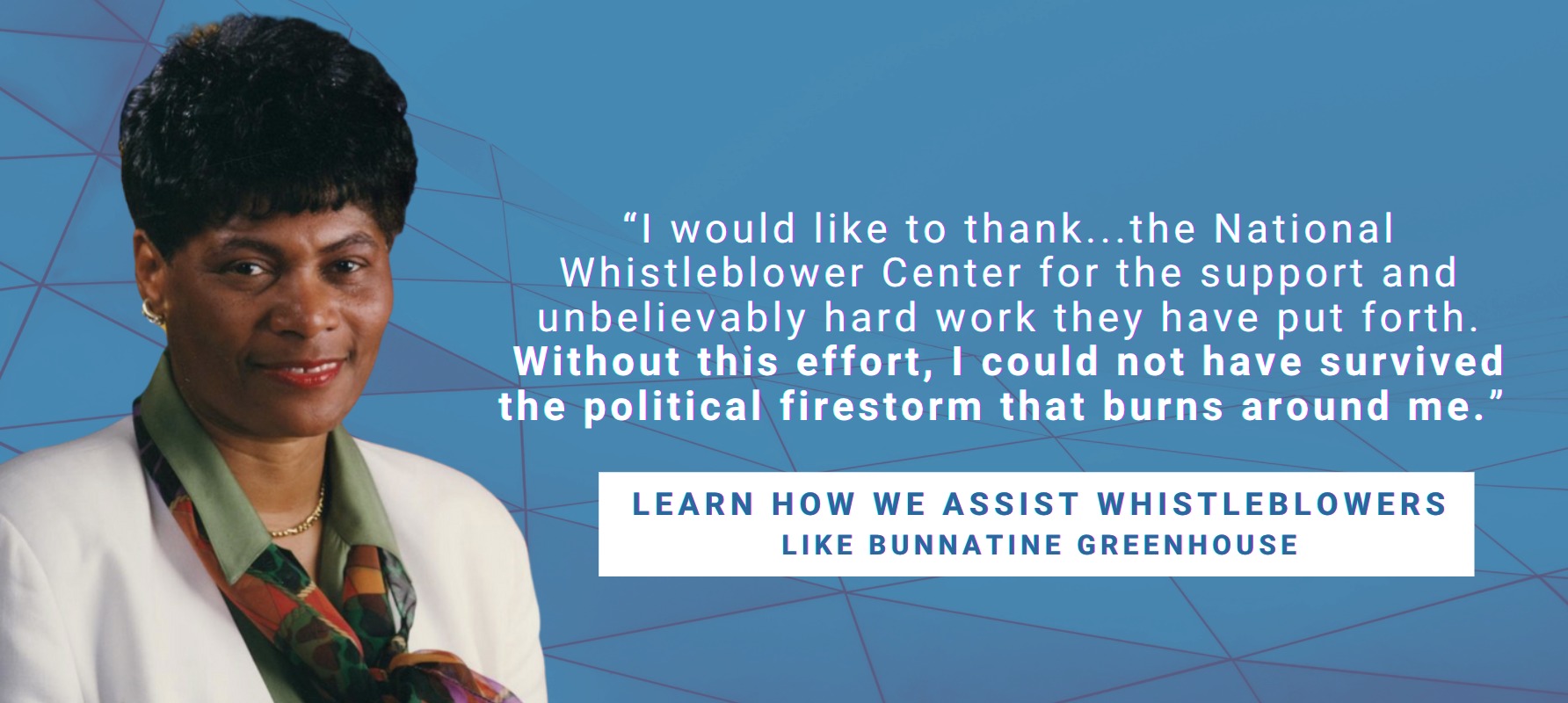
One of the cases that should be immediately independently reviewed is
the case of Bunnatine Greenhouse. Ms. Greenhouse was the former
Primary Assistant Responsible for Contracting (PARC) for the Army Corp
of Engineers, and in 2003, she was the only government official to
formally question the contracting process for the Iraq War. At the
height of public support for the War she issued a formal written
protest challenging the legality of the no-bid contract being awarded
to Halliburton for the reconstruction of Iraq. She paid for this
courageous stance with her job. She was removed from her Senior
Executive Service position, demoted and stripped of all authority over
government contracts.26
The majority of whistleblowers are unsung heroes who make tremendous
sacrifices for the good of society. Due to the highly pertinent nature
of her allegations, Ms. Greenhouse's extraordinary actions have been
documented in the media. Ty West, producer of the PBS program NOW,
wrote, "Bunny believes that good government requires a certain amount
of transparency, and that corruption is best deterred by
accountability. Her drive seems to flow from an ethical compass that
places public trust over personal comfort. It is a seemingly
unshakable personal resolve that guides and strengthens her convictions
and sustains her in her efforts to shine a bright light into the dark
corners of government." 27
Unfortunately, there are other cases equally compelling as Ms.
Greenhouse's. They also need to be independently reviewed. We can no
longer allow these individuals to suffer as a result of their
courageous actions.
J. The Special Case of National Security Whistleblowers
Since the 9/11 attacks, the need to adequately protect national
security whistleblowers has become urgent. Hundreds, if not thousands,
of employees in national security positions lost their jobs and careers
by pointing out deficiencies in America's anti-terrorism or national
defense programs.28
As a result of a defect in the WPA, many of these federal workers
have no whistleblower protections. After a careful review, the House
of Representatives concluded that these employees needed real
whistleblower rights, and included such protections in H.R. 985 (which
passed the House by a historic and veto proof majority, of 331 to 94).
President-Elect Obama has committed to ensuring that these federal
employees are adequately protected. In the NWC Survey, he endorsed
H.R. 985 and in his public statements he has drawn no distinction
between classes of federal employees who need protection.
The need for a case-by-case review of past instances of retaliation
is especially compelling for national security employees because they
have been without any meaningful protection. For example, in the FBI
the Department of Justice Office of Professional Responsibility
concluded that Supervisory Special Agent Bassem Youssef was retaliated
against after he complained that his expertise in counterterrorism was
not properly utilized. Mr. Youssef is the highest ranking fluent
Arabic speaker in the FBI, and was the recipient of the Director of
Central Intelligence Award in 1995 for his incredibly successful role
in infiltrating the Islamic Group (the group responsible for the first
World Trade Center bombings and whose boss was Osama Bin Laden's
spiritual leader).29 The FBI simply ignored the OPR report and continued to defend its position within the Department of Justice.
Similarly, the Department of Justice Office of Inspector General issued
a report that translator Sibel Edmunds was illegally fired as a
contractor for the FBI in retaliation for raising security/translation
concerns to her bosses. Despite the OIG report and findings, Ms.
Edmunds obtained no relief due to loopholes in the law, which excluded
FBI contract employees from any legal remedies.30
K. Demonstrate Bi-Partisan Commitment to Whistleblower Protection
Protecting whistleblowers is and should always be a non-partisan
issue. Ensuring honesty in government service, protecting taxpayers
from contractor-rip offs and demanding that the laws of the United
States be properly enforced is not a Democratic issue, a Republican
issue or an Independent issue. They are issues that impact all
Americans.
To demonstrate the bi-partisan commitment to whistleblower
protection, the new administration should hold a ceremony recognizing
whistleblowers for their courage and contribution to America. Senator
Grassley (R-IA), a champion of whistleblower protections since 1980,
has for years urged past presidents to conduct a non-partisan Rose
Garden ceremony for whistleblowers.31
President-Elect Obama should work with Senator Grassley's office
and organize the first annual ceremony. It will not only demonstrate
the new commitment to truly protecting whistleblowers, but also the
bi-partisan nature of this issue. It will send a message to all
branches of government that employees who raise concerns over waste,
fraud and abuse should have their allegations properly investigated,
and should never be the target of improper retaliation.
We recommend that March 2, 2009 be the date for this ceremony.
This is the anniversary of President Abraham Lincoln signing into law
America's first whistleblower protection act - The False Claims Act.
L. Appoint a Liaison for Whistleblower Issues within the White House
As is evident from the nature and scope of this Policy Paper,
numerous agencies and offices have a direct impact on whistleblower
protection. Given the diverse offices and organizations which have a
role in whistleblower investigations and adjudications, it is important
that there be a central point of contact in the White House.
Whistleblower advocacy groups can work with this liaison to ensure that
the policy goal of encouraging and defending whistleblowers is
achieved. President-Elect Obama promised to appoint a liaison for
whistleblower matters in the NWC survey.
IV. CONCLUSION
On May 8, 2007, President-Elect Barack Obama promised to support
significant whistleblower protection reforms. Not only did he approve
a NWC survey that committed his new administration to these policies,
he also often spoke in support of whistleblowers on the campaign trial
and incorporated whistleblower protections into his ethics agenda.
These policy positions reflect substantive changes that are
urgently needed. The changes are supported by the American people and
by the business community.
To ensure that real whistleblower protection is achieved the
following legislative and policy goals should be enacted within the
first 100 days of the new administration:
1. A national whistleblower protection act and the False Claims
Correction Act should be included as an essential component of any
oversight provisions in new "Bail Out" legislation or in another
appropriate legislative vehicle;
2. A new Special Counsel should be nominated who is a nationally recognized expert and champion for whistleblower rights;
3. Review the appointment process to ensure that all nominees are
committed to whistleblower protection and ensure that offices with
direct responsibility for protecting whistleblowers and/or
investigating their allegations are staffed with officials with a
demonstrated commitment to protecting whistleblowers;
4. Appoint a liaison for whistleblower issues and concerns within
the White House and empower that liaison to work with advocacy groups
and other the branches of the federal government to ensure that
whistleblowers are fully protected.
5. Conduct an independent review of cases that arose over the past
eight years to ensure that these whistleblowers receive justice.
6. Hold a bi-partisan Rose Garden ceremony celebrating whistleblowers on March 2, 2009.
7. Review administrative enforcement of whistleblower protection
programs at all executive agencies that have regulatory responsibility
in the area of whistleblower allegations and protection, and improve
regulations to enhance whistleblower protections.
8. Support new national whistleblower legislation and correction acts to existing whistleblower laws.
ENDNOTES
1. NWC survey signed by President-Elect Obama on May 8, 2007.
2.
After President-Elect Obama endorsed the NWC survey, other candidates
fully endorsed the policy initiatives, including Senators Hilary
Clinton and Christopher Dodd. NWC survey signed by Senator Clinton NWC survey signed by Senator Dodd.
3. The Ethics Agenda on President-Elect Obama's Web site
4. The PricewaterhouseCoopers study .
5. The only policy
initiative ranking higher then whistleblower protection concerned a
comprehensive review of all federal spending in order to ensure
accountability in these programs. "Audit every federal department and
agency to make sure their funding is going to meaningful projects,
instead of the bureaucracy."
6. The Democracy Corps Survey.
7. September 20, 2007 letter signed by 28 advocacy groups.
8. December 1, 2008 letter signed by 237 advocacy groups.
9. Justice Department Statistics on Fraud Recovery.
10. NWC Survey:
11. Candidates McCain, Biden, Brownback, Giuliani, and Hunter did not respond to the survey.
12. Testimony of Stephen M. Kohn
before the House Committee on Government Reform, "What Price Free
Speech?: Whistleblowers and the Garcetti v. Ceballos Decision" (June
29, 2006).
13. Testimony of Stephen M. Kohn
before the Senate Democratic Policy Committee, "Mistreatment of Iraq
Contracting Whistleblowers: The Need for Legislative Action" (September
21, 2007) .
14. The proposed whistleblower protection amendment.
15. Testimony of Stephen M. Kohn
before the Senate Committee on the Judiciary "The False Claims
Correction Act (S. 2041): Strengthening the Government's Most Effective
Tool Against Fraud for the 21st Century" (February 27, 2008).
16. CRS Report for Congress "The False Claims Act, the Allison Engine Decision, and Possible Effects on Health Care Fraud Enforcement" (November 6, 2008).
17. Joe Davidson, "Workers Applaud Special Counsel's Return to Private Sector", Washington Post, October 22, 2008.
18.
Historically, the whistleblower community has been disappointed by the
failure of the Office of Special Counsel to aggressively champion
whistleblower cases. The failures of this office hit new lows in 2008
when the FBI raided the Office and seized materials from the Special
Counsel as part of a criminal probe into misconduct by the Special
Counsel himself. Carrie Johnson and Christopher Lee, "Federal Agents Raid Office of Special Counsel," Washington Post, May 7, 2008.
Shortly before the November election, President Bush was forced to fire
the Special Counsel as a result of his performance problems. Carrie
Johnson, "Special Counsel Bloch Resigns Under Pressure," Washington Post, October 24, 2008.
19. Eric Lichtblau, "Report Assails Political Hiring in Justice Dept.," New York Times, June 25, 2008.
20. Between 1995 and 2005, only two out of 30 whistleblowers prevailed on the merits before the Merit Systems Protection Board ("MSPB"), and only one whistleblower claim out of 96 prevailed on the merits before the U.S. Court of Appeals for the Federal Circuit. See CRS Report for Congress: National Security Whistleblowers (Dec. 2005). Since 2005, these negative trends have worsened to the point where less than 5% of whistleblowers win their cases before the MSPB and only 1% win their appeals on review to the Federal Circuit. By contrast, in the year 2000, the Justice Department's Bureau of Justice Statistics (BJS) reported that in civil rights cases filed in federal court between 1990-1998, on average, plaintiffs won 35% of jury trials annually, compared to 23% of the trials decided by judges.
21. December 1, 2008 letter signed by 237 advocacy groups.
22. Transparency International Study "Corruption Risks in Hungary: Part One".
23. NWC Press Release "Hungarian Prime Minister Proposes Whistleblower Protections" November 4, 2008 (Contains links to Hungarian newspaper articles). NWC Press Release "Hungary's Justice Minister Announces Whistleblower Initiative" October 20, 2008 (Contains link to Stephen M. Kohn's Power Point presentation in Hungary); MTI Daily Bulletin, November 11, 2008 (Hungarian newspaper article in English).
24. Press
Release of Congressman Rohm Emmanuel "Emanuel Attacks Appointment of
Rove to Oversee Flood Relief; Cites Bush Administration Treatment of
Whistleblowers" February 16,
2005:http://www.whistleblowers.org/storage/whistleblowers/documents/emanuel%20whistleblower%20statement%20.pdf
25. Statement by Senator Daniel K. Akaka's (D-HI) "Congress Must Strengthen Whistleblower Protections" September 8, 2006.
26.Senate Democratic Policy Committee Report "Major Findings: DPC Oversight Hearings on Iraq Contracting Abuses" April 22, 2008.
Neely Tucker, "A Web of Truth: Whistle-Blower or
Troublemaker, Bunny Greenhouse Isn't Backing Down", Washington Post,
October 19, 2005:
http://www.whistleblowers.org/storage/whistleblowers/documents/a_web_of_truth.pdf
"A Web of Truth: Whistle-Blower or Troublemaker, Bunny Greenhouse Isn't Backing Down"; Testimony of Bunnatine H. Greenhouse before the Senate Democratic Policy Committee, "Abuses in Private Security and Reconstruction Contracting in Iraq:
Ensuring Accountability, Protecting Whistleblowers" (September 21, 2007).
27. John Siceloff
and Jason Maloney, Your America: Democracy's Local Heroes (New York:
Palgrave MacMillan, 2008), cover, 137,154. bunny book cover final and excerpts on Ms. Bunnatine Greenhouse. Additional Excerpts.
28. A 2007 ACLU report - Disavowed: The Government's Unchecked Retaliation Against National Security Whistleblowers.
Lecture of Stephen M. Kohn at the American University/Government
Accountability Project Seminar on The Special Case of National Security
Whistleblowers, "Avoiding Traps, Makng Change and An Effective Legislative Response", (June 23, 2008).
29. Department of Justice Office of Professional Responsibility Report "Report of Investigation of Whistleblower Allegations by Federal Bureau of Investigation Special Agent Bassem Youssef" (July 3, 2006).
30. A Review of the FBI's Actions in Connection with Allegations Raised By Contract Linguist Sibel Edmonds.
31. Grassley Floor Statements on Whistleblower Week and calling for a Rose Garden ceremony; Greenhouse statement giving award to Senator Grassley; NWC Press Release "25 Whistleblower Advocacy Groups Present Senator Chuck Grassley with Lifetime Achievement Award" May 17, 2007.