

-
-
TAKE ACTION!
Senator Grassley Asks If FDA Monitored All Employees the Same as Whistleblowers
Washington, D.C. February 2, 2012. Senator Charles E. Grassley (R-Iowa) launched an investigation in response to a lawsuit filed by six FDA whistleblowers and documents released by the National Whistleblowers Center that show the FDA targeted whistleblowers for special monitoring and intercepted personal communications to Congress, including emails to Senator Grassley's staff.
Senator Grassley, the Ranking Member of the Senate Judiciary Committee and a highly respected advocate of government oversight, launched an investigation into the FDA's targeted monitoring of whistleblowers. The Senator specifically asked FDA Commissioner Margaret Hamburg whether or not whistleblowers were singled out for special monitoring based on a letter they wrote to President-Elect Obama's Transition Team.
-
April 2, 2009 letter from FDA scientists to President Obama concerning the misdeeds of FDA offiicials who have failed to protect the public and who have retaliated against employees who spoke out against their actions.
-
January 7, 2009 letter from FDA scientists to John Podesta, Chief of the Presidential Transition Team, informing him that "the scientific review process for medial devices at FDA has bee corrupted and distorted by current FDA managers" and explaining how to reform the FDA to fulfill its mission of protecting the public.
-
November 17, 2008 letter from Representatives John D. Dingell and Bart Stupak to the Commissioner of the FDA, Andrew C. von Eschenbach, urging him to "take seriously the allegations of the CDRH scientists and physicians and take the necessary immediate actions with respect to managements, procedural and organizational changes necessary to assure the safety and effectiveness of medical devices."
-
October 14, 2008 letter from FDA scientists to Rep. John D. Dingell seeking intervention because "serious misconduct by managers of the U.S. Food and Drug Administration (FDA) at the Center for Devices and Radiological Health (CDRH) is interfering with our responsibility to ensure the safety and effectiveness of medical devices."
-
-
UNDER CONSTRUCTION
In 1997 the case of FBI whistleblower Dr. Frederic Whitehurst prompted President Clinton to issue an executive order enforcing FBI whistleblower protections. These protections are not perfect, but they have allowed FBI employees to come forward and report civil liberties and civil rights abuses. Currently, the Senate is "hotlining" the Whistleblower Protection Enhancement Act (S. 372), which means it could pass without any public debate or vote. This bill eliminates the protections FBI employees have currently. S. 372 must be fixed now.
TAKE ACTION NOW! Read Fred Whitehurst's letter and urge your Senator to contact the Senate Committee on Homeland Security and Governmental Affairs to ensure S. 372 is fixed!
Why does the FBI want to get rid of protections provided under 5 U.S.C. § 2303?
Under 5 U.S.C § 2303, FBI whistleblowers have the right to independent review of their claim, either by the Office of the Inspector General or the Office of Professional Responsibility.
The following reports are examples of these independent reviews, which have resulting in findings critical of the FBI. It is no wonder they are lobbying aggressively to push S. 372 through the Senate. If S. 372 passes as is, independent IG and OPR investigations like those listed below, will cease to exist:
A Review of the Federal Bureau of Investigation's Use of Exigent Letters and Other Informal Requests for Telephone Records, January 2010
A Review of the FBI's Use of National Security Letters: Assessment of Corrective Actions and Examination of NSL Usage in 2006
A Review of the FBI's Actions in Connection With Allegations Raised by Contract Linguist Sibel Edmonds, January 2005
Investigation Regarding Removal of Tiffany Globe from the Fresh Kills Recovery Site, December 2003
A Review of the FBI's Response to John Roberts' Statements on 60 Minutes, February 2003
Double Standards Report
The FBI Laboratory: An Investigation into Laboratory Practices and Alleged Misconduct in Explosives-Related and Other Cases, April 1997
The FBI Laboratory One Year Later: A Follow-Up to the Inspector General\'s April 1997 Report on FBI Laboratory Practices and Alleged Misconduct in Explosives-Related and Other Cases, June 1998
-
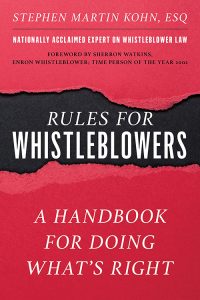
March 23, 2010. Washington, D.C. Stephen M. Kohn, Executive Director of the National Whistleblowers Center, has agreed to participate in an independent debate with Mr. Norman L. Eisen, Special Counsel to the President for Ethics and Government Reform, regarding the Whistleblower Protection Enhancement Act (S. 372), which is currently being "hotlined" in the Senate. Mr. Eisen has currently declined the invitation to participate in the debate.
-
Changes to the Whistleblower Protection Enhancement Act currently working its way through the Senate would cover up intelligence failures and civil liberties abuses in the Federal Bureau of Investigation (FBI) by repealing existing protections for FBI whistleblowers and strengthening the state secrets privilege.
Mary Jane Wilmoth: truthout reports WPEA being "hotlined"
The bill is currently being "hotlined" through the Senate, which entails both the Senate majority leader and minority leader agreeing to pass the legislation by unanimous consent without a roll-call vote. This practice is usually used to pass uncontroversial bills and simple procedural motions, but opponents fear it is being used to push through this measure with little or no public debate.
TAKE ACTION!
For years we have asserted that effective federal employee whistleblower reform requires court access, and that the politically appointed Merit Systems Protection Board (MSPB) fails to effectively protect federal employee whistleblowers. New data obtained under the Freedom of Information Act proves that the watered-down Senate Whistleblower Protection Enhancement Act (S. 372) will not work.S. 372 repeals existing FBI protections and expands state secrets privilege
Washington, D.C. March 10, 2010. Prominent national security whistleblowers and advocacy groups issued a letter today urging the Senate to vote against the Whistleblower Protection Enhancement Act of 2009 (S. 372) unless the dangerous national security whistleblower provisions are corrected. This bill, which is currently being “hotlined” for unanimous consent, repeals existing FBI protections and strengthens the state secrets privilege.
The letter, signed by national security whistleblowers and respected advocates for national security employees, explains in detail the deficiencies in the Senate bill that will harm national security by covering up intelligence failures and civil liberties abuses:
The Whistleblower Protection Act (S. 372) is pending in the Senate and seeks to clarify the rules and protections that cover whistleblowers.
Some, however, think it will have the opposite effect, and it's drawing fire from some whistleblower groups.
Results 21 - 30 of 94
-