Seeking Expert Commentary or an Interview? Contact Us
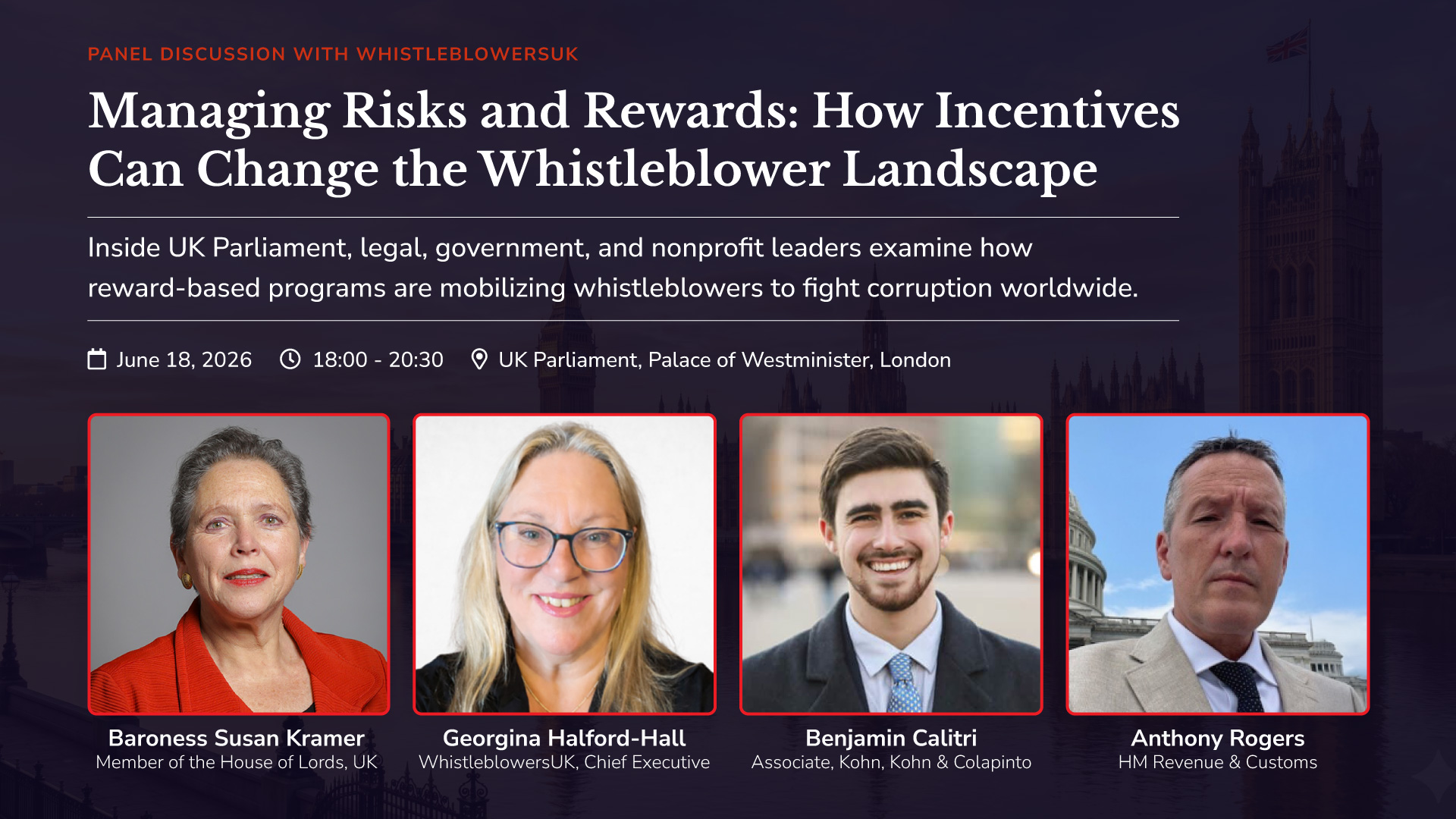
Managing Risks and Rewards: How Incentives Can Change the Whistleblower Landscape
Corruption thrives wherever wrongdoing goes unreported, and for those who can speak up, reporting often carries real personal and professional risks. The most effective answer has proven to be incentives: programs that protect whistleblowers and reward them for coming forward.
Join the National Whistleblower Center and WhistleblowersUK for an evening in UK Parliament examining how US-style whistleblower reward programs work, why they succeed, and how they can be adapted by governments around the world to combat fraud and corruption. The discussion will spotlight emerging models such as HMRC’s Strengthened Reward Scheme, which mobilizes whistleblowers to report tax fraud, and explain what their momentum means for the future of global enforcement.
Speakers from the legal, nonprofit, and government sectors will share firsthand perspectives on the ongoing effort to establish and implement rewards-based programs internationally — and the practical lessons emerging along the way.
Attendance is by invitation and capacity is strictly limited. To indicate your interest, please complete the form below. We will follow up with a separate invitation.
Further Reading
Alice Wanamaker, Jeana Lee & Benjamin Calitri, Business As Usual? The Surprising Alignment Between Corporate Defense Firms and Whistleblowers, Oxford Bus. L. Blog (Apr. 20, 2026), https://blogs.law.ox.ac.uk/oblb/blog-post/2026/04/business-usual-surprising-alignment-between-corporate-defense-firms-and.
Stephen M. Kohn, A Reverse Marshall Plan for Anti-Corruption: Liberal Democracies Can Fill the Void Left by The Changes in U.S. Policies, Nat’l Whistleblower Ctr., https://www.whistleblowers.org/wp-content/uploads/2026/06/A-Reverse-Marshall-Plan-for-Anti-Corruption.pdf.
Stephen M. Kohn, Why Whistleblowing Works: A New Look at the Economic Theory of Crime (Apr. 16, 2024), https://ssrn.com/abstract=4796825.
Eliza Lockhart, The Inside Track: The Role of Financial Rewards for Whistleblowers in the Fight Against Economic Crime (SOC ACE Research Paper No. 31, 2024), https://www.whistleblowers.org/wp-content/uploads/2026/06/SOC-ACE-RP31_Whistleblowing-Dec24.pdf.
Speakers

Baroness Susan Kramer
Member of the House of Lords, UK
The Rt Hon. the Baroness Kramer (Susan Veronica Kramer) is a current member of the House of Lords and one of Parliament’s leading voices for whistleblower reform. A Liberal Democrat peer, she is a former Minister of State for Transport and now serves as the party’s Lords spokesperson for Treasury and the economy. She has been a persistent advocate for stronger protections and incentives, championing an Office of the Whistleblower Bill in the House of Lords and, more recently, helping secure a landmark amendment to the Employment Rights Bill that introduces a duty on larger employers to investigate whistleblowing concerns. She has openly pointed to the success of US-style reward programs, noting in the Lords that roughly a quarter of the US CFTC’s cases have stemmed from tips by UK whistleblowers — making her a fitting voice for this discussion on rewards and incentives.

Georgina Halford-Hall
WhistleblowersUK
Georgina Halford-Hall is the Chief Executive of WhistleblowersUK and serves as Director of Strategy & Policy for the All-Party Parliamentary Group for Whistleblowing. She came to the cause firsthand: she founded WhistleblowersUK after blowing the whistle on financial irregularities and poor practice at a charity, discovering how isolated and unsupported whistleblowers often are once they speak up.
Over the years since, she has built the case for stronger UK whistleblower protections, supported whistleblowers in defending their cases at tribunal, and helped drive the campaign to establish an Office of the Whistleblower — a body intended to protect whistleblowers, sanction those who retaliate, and educate the public on their rights. As a leading advocate for reform, she is a natural co-host for this discussion on incentives and the future of whistleblowing.

Benjamin Calitri
Associate, Kohn, Kohn & Colapinto
Benjamin is an experienced associate attorney at Kohn, Kohn & Colapinto, representing whistleblowers in retaliation and award cases. Ben has filed award claims for whistleblowers under the Dodd-Frank Act with the Securities and Exchange Commission (SEC) and Commodity Futures Trading Commission (CFTC).
Similarly, he has filed tax evasion claims with the Internal Revenue Service (IRS), money laundering/sanctions violations cases with the Financial Crimes Enforcement Network (FinCEN) and False Claims Act cases in federal court. To date, whistleblowers Ben has represented have worked with the United States in recovering over $5 billion in sanctions.
Ben also is active in representing whistleblowers who have suffered retaliation, including cases filed under the Sarbanes-Oxley Act, and arbitration cases under FINRA’s Alternative Dispute Resolution. Ben has developed expertise in combating illegal non-disclosure agreements and representing clients in cryptocurrency claims.
An accomplished speaker, Ben has been a featured presenter at the Association of Certified Fraud Examiners’ White Collar Crime Conference, Anti-Fraud Coalition’s Annual Conference, and Whistleblower UK’s Whistleblower Awareness Week held in London, among others. He is also a member of the Whistleblower UK’s attorneys committee.
Ben has also published extensive articles in publications such as the Financial Times, Oxford Business Law Blog, Columbia Law School Blue Sky Blog, New York University School of Law Program on Corporate Compliance and Enforcement, Law360, and National Law Review.
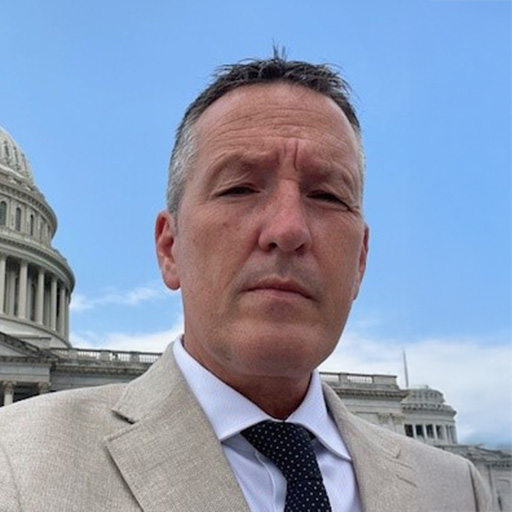
Anthony Rogers
Source Management Operations – Risk & Intelligence Service
HM Revenue & Customs is the United Kingdom’s tax, payments, and customs authority, responsible for collecting the revenue that funds the country’s public services and for tackling tax avoidance and evasion. HMRC sits at the center of this conversation following a landmark policy shift: its new Strengthened Reward Scheme, confirmed in the Autumn Budget 2025 and modelled on the US IRS Whistleblower Program. Under the scheme, whistleblowers whose information leads to the recovery of at least £1.5 million in tax can qualify for a reward of between 15% and 30% of the amount collected, with the program targeting high-value evasion involving offshore schemes, wealthy individuals, and large corporations. The scheme marks a clear departure from the UK’s traditional reluctance to financially reward whistleblowers, making HMRC’s perspective central to any discussion of how incentives can reshape the whistleblower landscape.

Gary Forbes
Senior Case Consultant
I am a Senior Case Consultant in HMRC’s Risk & Intelligence Service (RIS) having previously spent 30+ years in fraud investigation.
Highlights include heading HMRC’s Criminal Taxes Unit and establishing, then leading, multi-disciplined investigation and asset recovery teams in the Fraud Investigation Service (Economic Crime). I also designed a compliance process to counter criminal attacks on HMRC systems. This process has been used as a blueprint to protect against further attacks.
Away from work, I am married with 4 children (aged 19 – 36), and have one adorable granddaughter, Nora, who is two years old. I am a Fellow of the Association of Taxation Technicians (ATT) and a Chartered Manager (CMI). Currently learning British Sign Language (BSL).
Interested in Attending? Fill out the Discussion Interest Form
Please fill out the form below if you're interested in attending.
This is an interest form only, not an official sign-up form.
Discussion Date
The National Whistleblower Center and WhistleblowersUK convene leaders from law, government, and the nonprofit sector inside the Palace of Westminster to examine how US-style whistleblower reward programs are reshaping the global fight against corruption — including HMRC's new Strengthened Reward Scheme for reporting tax fraud.