There is no limit to the amount of news content an individual can consume. But when whistleblowers go to the media, they demonstrate their unique ability to cut through the noise, misinformation and disinformation to reach the public and lawmakers who can take appropriate action.
Whistleblowers who go to the media do so for good reason. Disclosures to the media can inform consumers of fraudand pressure companies to act long before a slow, confidential government investigation can be completed. Under a major international anti-bribery law, an audit recently found that one in five successful prosecutions came from media tips. In short, collaboration between whistleblowers and the news media is one of the most important mechanisms to prevent fraud and corruption, both in the U.S. and worldwide.
On July 30, the National Whistleblower Center (NWC) will hold its annual celebration of National Whistleblower Day, commemorating the date in 1778 when Congress passed the first-ever whistleblower law. This year’s celebration will focus on media-whistleblower collaboration, featuring speeches from high-profile journalists and whistleblowers who used the media to great effect when warning the public about corrupt conduct. To join the waitlist to attend this year’s National Whistleblower Day celebration on Capitol Hill, visit www.nationalwhistleblowerday.org/rsvp.
In the spirit of National Whistleblower Day, this Sunday Read celebrates three whistleblowers whose presence and impact on the media has been vital to protecting public health and democracy at large.
Dr. Jeffrey Wigand: Big Tobacco Whistleblower
Dr. Jeffrey Wigand stands as one of the most consequential whistleblowers in modern public health. Wigand exposed how Brown & Williamson and the broader tobacco industry manipulated nicotine and concealed the dangers of smoking. As the company’s former vice president of research and development, he had firsthand knowledge of internal practices, which made his disclosures especially powerful and credible. By speaking out on “60 Minutes” in 1996 – and violating his non-disclosure agreement (NDA) – he helped bring hidden industry conduct into public view and strengthened the case for government action against tobacco companies.
Wigand’s whistleblowing came at a steep personal cost. Brown & Williamson retaliated with litigation and efforts to discredit him, and his life and career were deeply affected by the fallout. Even so, his cooperation with investigators and his televised interview helped create the evidentiary momentum that supported major tobacco reform efforts. His story became a landmark example of the risks whistleblowers face when they challenge powerful corporations and his courtroom testimony resulted in a historic $206 billion settlement against Brown & Williamson.
The ordeal was so riveting that it inspired the 1999 Michael Mann film, “The Insider,” which was nominated for five Academy Awards, including Best Picture and Best Actor for Russell Crowe’s portrayal of Wigand.
In 2024, Wigand was a keynote speaker at National Whistleblower Day, where he received NWC’s first Lifetime Achievement Award. The honor recognized more than a famous disclosure; it acknowledged the lasting public health impact of Wigand’s courage. His actions helped expose the tobacco industry’s efforts to addict consumers, fueled broader accountability efforts, and inspired future whistleblowers to see that insider truth-telling can change policy, litigation, and public understanding.
“To try to capture the last 30 years after basically sticking it to the tobacco industry and their NDA, I was able to start a process that has created what I would call ‘conscience in action,’” Wigand said while receiving his award in 2024. He detailed the smear campaigns and death threats he received ahead of his court appearances in an effort to discredit him. “But if it wasn’t for the Wall Street Journal, the New York Times and the LA Times who debunked the garbage [Big Tobacco] put out … I would never be believed.”
Daniel Ellsberg: Exposing Unethical and Deadly Government Actions
Daniel Ellsberg’s leak of the “Pentagon Papers” was a turning point in the history of whistleblowing. Ellsberg exposed how successive administrations had misled the public about the Vietnam War, fundamentally shifting the American people’s relationship with the federal government and demonstrating that a government insider could bring wrongdoing into the open.
While employed by the RAND Corporation, a non-partisan American nonprofit global policy think tank that is still active today, Ellsberg and colleague Anthony Russo secretly photocopied the corporation’s 7,000-page study which had been confidentially drafted for the government. In compiling “The Pentagon Papers,” Ellsberg and Russo determined in 1968 that the U.S. government was aware it could not win the Vietnam War, but still proceeded to engage and cost the lives of thousands of U.S. soldiers. The two attempted to persuade U.S. Senators to release the papers on the Senate floor, but ultimately Ellsberg decided to risk prison and leak the documents to the New York Times and Washington Post in 1971.
Ellsberg’s courage shook America to its foundations, as the Papers demonstrated how five presidential administrations misled the American people about the Vietnam War, which was at the core of chaos in the country and the world at the time.
Ellsberg’s case also highlighted the danger faced by whistleblowers under the Espionage Act, underscoring the need for stronger legal protections. This fight continues today, as NWC is actively campaigning to improve due process rights for federal whistleblowers.
Beyond the “Pentagon Papers,” Ellsberg became a lasting symbol of courage and accountability. He went on to publish several books, including 2018’s The Doomsday Machine. His actions influenced public understanding of whistleblowing, inspired later generations to challenge official secrecy, and helped expand the modern whistleblower movement by linking disclosure to democratic oversight and national safety. His contributions helped redefine whistleblowing as a legitimate and necessary form of civic action.
Desiree Fixler: Financial Whistleblower and National Whistleblower Day 2026 Speaker
Desiree Fixler emerged as a significant whistleblower in the financial services sector by publicly raising concerns that Deutsche Bank in 2021. She exposed how the bank, through its asset management arm DWS, was overstating its environmental, social, and governance (ESG) commitments – better known as “greenwashing” – and misleading investors about these factors were integrated into its investment process.
Her disclosures helped trigger regulatory scrutiny in the U.S. and abroad, and the Securities and Exchange Commission (SEC) later imposed a $19 million penalty on the firm’s asset-management division. That result underscored the value of insider reporting in exposing greenwashing and other forms of corporate misrepresentation.
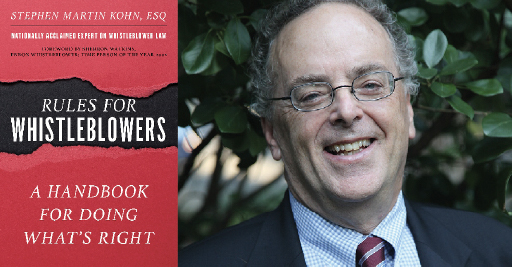
Fixler’s story is also important because it highlights the practical limits of whistleblower reward programs. Although Fixler assisted investigators for years and spent substantial time helping build the case, the SEC denied her award on the ground that the agency first learned of her concerns from the media rather than directly from her. In May 2026, her attorney, NWC Board Chair Stephen Kohn appealed her award denial in the U.S. Court of Appeals for the D.C. Circuit.
Fixler will deliver her perspective on Capitol Hill on July 30, 2026, as a keynote speaker at this year’s celebration National Whistleblower Day. “Desiree’s appeal has turned her case into a broader discussion about what it means for a tip to be ‘voluntary’ and whether speaking to the press should disqualify a whistleblower who has extensively assisted federal investigators from receiving an award,” said Alice Wanamaker, a Public Interest Law Fellow at Kohn, Kohn & Colapinto who is assisting with the appeal of Fixler’s award denial. “Her actions reinforced the idea that whistleblowers can serve as essential checks on corporate branding, especially when public messaging and internal conduct diverge.”