Emergency Deadline (June 1, 2026): FinCEN must enact laws that fully protect whistleblowers.
Submit Your Comment

June 1 Deadline to Submit Comments to Ensure AML Will Work and Protect and Award Whistleblowers

FinCEN’s proposed rules could gut the most powerful anti-corruption law ever passed. You can change that! The deadline to submit a legally binding public comment is June 1, 2026, so act now.

Submit Comment Now
FinCEN Proposed Rulemaking
EMERGENCY ACTION NEEDED

June 1 Deadline to Submit Comments to Ensure AML Will Work and Protect and Award Whistleblowers

FinCEN’s proposed rules could gut the most powerful anti-corruption law ever passed. You can change that! The deadline to submit a legally binding public comment is June 1, 2026, so act now.

Submit Comment Now

Please Submit Your Comment Today!

The deadline for legally binding public comments is June 1, 2026, so please take 5 quick minutes to support courageous whistleblowers by submitting a comment to FinCEN.

This is not a petition. It is a federal regulatory comment — and it carries legal force. Filing your comment with FinCEN is a generational opportunity to weigh in on the most important whistleblower rulemaking in the past 15 years.

Our Comment

NWC has carefully studied the proposed regulations and developed 19 comments to improve them. If these comments are implemented, FinCEN’s rules will make the AML WIA one of the most effective domestic and transnational whistleblower laws to date. If they are rejected, the AML WIA will fail to protect the overwhelming majority of potentially meritorious whistleblowers.

View NWC's Comment
Submit Comment

How to submit your comment

Select the version that best fits your background. Personalize the bracketed fields with your own name, organization (if any), and personal connection to the issue — personalized comments carry more weight than form letters.

2

Type your comment or upload it as a document

There is a template provided below.

3

Complete the short identifying information form

Choose which identity best represents you.

4

Submit Comment

Click to submit your comment!

  • Comment Template

    Re: Proposed Rules Implementing the Anti-Money Laundering Whistleblower Improvement Act

    Docket: FINCEN-2026-0067

    My name is [YOUR NAME]. I am [a concerned citizen / a supporter of anti-corruption efforts / briefly describe your connection to this issue].

    I am writing to urge FinCEN to strengthen — not weaken — the rules implementing the Anti-Money Laundering Whistleblower Improvement Act. Congress passed this law to reward and protect the people who come forward with information about money laundering, terrorist financing, and financial crime. The proposed rules fall short of that mandate.

    I urge FinCEN to adopt the AML rulemaking comment submitted by the National Whistleblower Center. I am particularly concerned that the rules fail to implement the mandatory confidentiality requirements essential for the law to work, create technical procedural barriers that disqualifying good-faith whistleblowers, fail to protect international whistleblowers who face severe dangers, and add disqualifications that Congress never authorized.

    FinCEN should implement regulations that fully support American and international whistleblowers who risk their jobs, careers, and safety by alerting the authorities to corrupt financial transactions through media reports, working with anti-corruption organizations, disclosing violations to their employer, or reporting directly to the government.

    The people who expose money laundering, transnational organized crime, and violations of the Bank Secrecy Act deserve meaningful protection. I urge FinCEN to get these rules right.

    Sincerely,

    [YOUR NAME]
    [CITY, STATE — optional]
    [ORGANIZATION, if any — optional]

  • NGO / Advocacy Professional

    Re: Comments on Proposed Rules, Anti-Money Laundering Whistleblower Improvement Act

    On behalf of [ORGANIZATION NAME / myself], I submit these comments in response to FinCEN’s proposed rules implementing the Anti-Money Laundering Whistleblower Improvement Act (AML WIA), 91 Fed. Reg. 16328 (April 1, 2026).

    [ORGANIZATION NAME / I] support strong and effective implementation of the AML WIA. The proposed rules, however, fall short of Congressional intent in several critical respects.

    First, the proposed definition of “voluntary” reporting is overly restrictive and inconsistent with the statute. Whistleblowers who report to employers, NGOs, news media, or foreign law enforcement before filing a government form should not be disqualified. Congress explicitly recognized diverse reporting channels in 31 U.S.C. § 5323.

    Second, the proposed rules fail to address the specific circumstances of international whistleblowers, who lack U.S. anti-retaliation protections and face grave physical risks. These are often the most critical sources of information on transnational financial crime.

    Third, the proposed rules disqualify categories of persons — including foreign officials and compliance officers — that Congress did not exclude. Under Loper Bright Enterprises v. Raimondo (2024), agencies must follow the plain text of the statute.

    I urge FinCEN to revise its proposed rules to fully implement the AML WIA in accordance with Congressional intent and to maximize protections and incentives for all qualifying whistleblowers.

    Respectfully submitted,

    [YOUR NAME]
    [TITLE]
    [ORGANIZATION]
    [EMAIL — optional]

  • Industry Insider / Potential Whistleblower

    Re: Proposed AML Whistleblower Rules — Docket FINCEN-2026-0067

    My name is [YOUR NAME].

    I work in [financial services / compliance / banking / a related field — describe briefly without compromising your identity]. I am submitting this comment because the rules FinCEN is proposing would make it harder — not easier — for people like me to come forward with information about financial crime.

    The proposed rules require that a whistleblower file a specific government form before taking almost any other action. In practice, that is not how people discover and report wrongdoing. People report to supervisors. They contact lawyers. They reach out to journalists or regulators in other countries. Penalizing someone for doing those things first — before finding a government form — discourages reporting and protects wrongdoers.

    The proposed rules also fail to address how FinCEN will protect international sources. There is no meaningful confidentiality guarantee for someone reporting from outside the United States, and no clear path to anonymity. That is a serious gap.

    If FinCEN wants the AML whistleblower program to succeed, the rules need to be accessible, realistic, and genuinely protective. I urge FinCEN to adopt rules that reflect how whistleblowers actually work — and to honor the intent of the law Congress passed.

    [YOUR NAME]
    [LOCATION — optional]

The Issue with FinCEN’s Proposed Rules

The Financial Crimes Enforcement Network (FinCEN) within the U.S. Treasury Department has published proposed rules implementing the Anti-Money Laundering Whistleblower Improvement Act (AML WIA).

As detailed in comments the NWC submitted to FinCEN, the proposed rules threaten to nullify the AML WIA before it ever gets off the ground.

Problems with the proposed rules include:

  • Strict, non-statutory filing requirements that will disqualify countless whistleblowers who Congress intended to be eligible for awards,
  • A failure to acknowledge and protect international whistleblowers, who provide the U.S. with critical whistleblower tips at great risk to their lives, and
  • Weakened confidentiality requirements, which are inconsistent with the statutory requirements and put whistleblowers at risk.

The Challenges Whistleblowers May Face

Financial crime is global. The insiders best positioned to expose it — bank employees, compliance officers, accountants operating in foreign countries — often work in places with no whistleblower protections and at risk of their lives.

More than 30 international whistleblowers have been murdered or imprisoned for exposing financial wrongdoing. FinCEN’s proposed rules ignore this reality. They impose technical procedural requirements that will disqualify the most valuable whistleblowers and add exclusions that Congress never authorized.

Your Comment is The Solution!

Your voices are critical to ensure that the AML WIA properly protects whistleblowers, increases in enforcement, and targets financial networks that facilitate crime. File your comment today and join thousands of others in this historic moment.

Questions or Comments?

Jeana Lee

Programs Manager

"This is a pivotal turning point. If FinCEN gets these rules right, the AML WIA could dwarf every whistleblower program that came before it."

Submit Your Comment

2

Type your comment or upload it as a document

There is a template provided below.

3

Complete the short identifying information form

Choose which identity best represents you.

4

Submit Comment

Click to submit your comment!

Submit Comment

The Critical Failures

What's Wrong With FinCEN's Proposed Rules

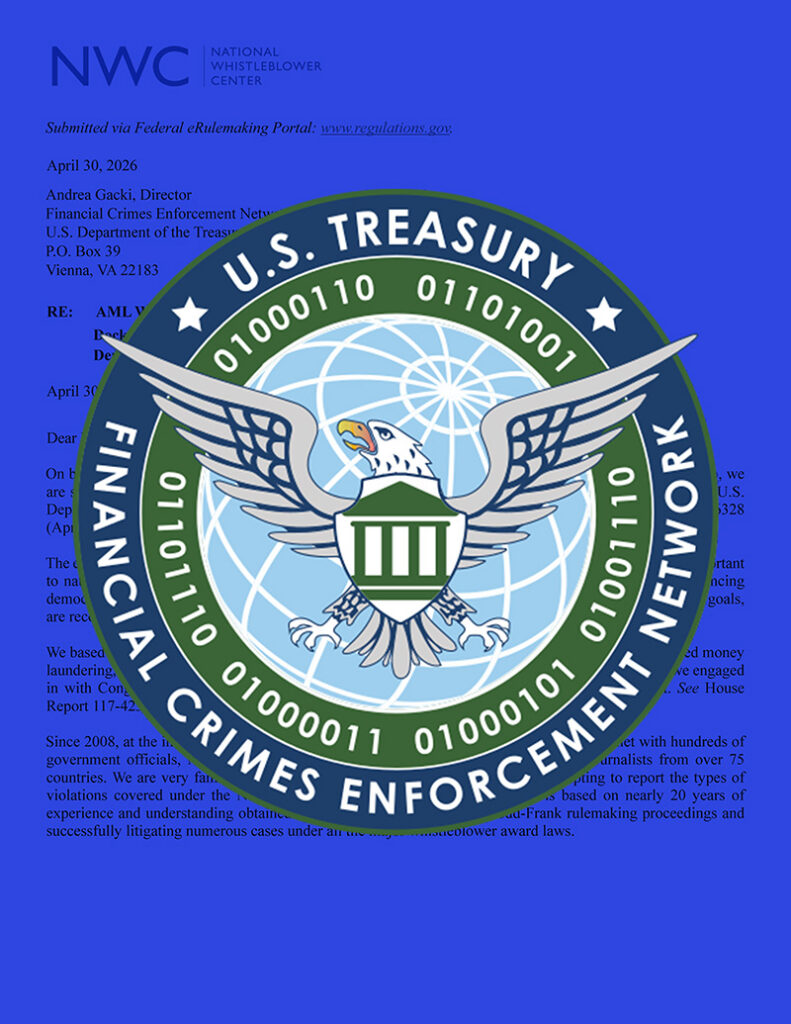
NWC Chairman Stephen Kohn and the law firm of Kohn, Kohn & Colapinto submitted a detailed 19-section legal analysis on April 30, 2026. Three core failures define the proposed rules.

The proposed rules define “voluntary” disclosure in a way that excludes whistleblowers who reported to another agency before filing with FinCEN — even when that sequence was legally required or explicitly permitted by law. FinCEN also proposes to impose strict filing requirements for the Tip, Complaint, or Referral (TCR) form that could disqualify otherwise meritorious whistleblowers on purely technical grounds, even when the underlying information led directly to a successful enforcement action. Congress did not authorize these disqualifications. They appear nowhere in the statute.

More than 30 named international whistleblowers have been murdered or imprisoned for reporting financial crimes. The AML WIA was designed with these individuals in mind — people in Panama, Russia, the Cayman Islands, and elsewhere who have access to evidence of money laundering networks that fund terrorism, narcotics trafficking, and authoritarian corruption. FinCEN’s proposed rules provide no retaliation protection for whistleblowers outside U.S. jurisdiction. An international whistleblower who reports under these rules and is subsequently retaliated against abroad has no legal remedy. This is not a gap Congress intended. It is a gap FinCEN created.

FinCEN’s proposed rules add disqualifications for whistleblowers that are not found anywhere in the AML WIA. This is directly prohibited by the Administrative Procedure Act and by the Supreme Court’s 2024 ruling in Loper Bright Enterprises v. Raimondo, which held that courts — not agencies — determine the meaning of federal statutes. An agency cannot expand the class of people excluded from a program beyond what Congress specified. FinCEN’s rule attempts to do exactly that. Under binding Supreme Court precedent, those additions cannot stand.