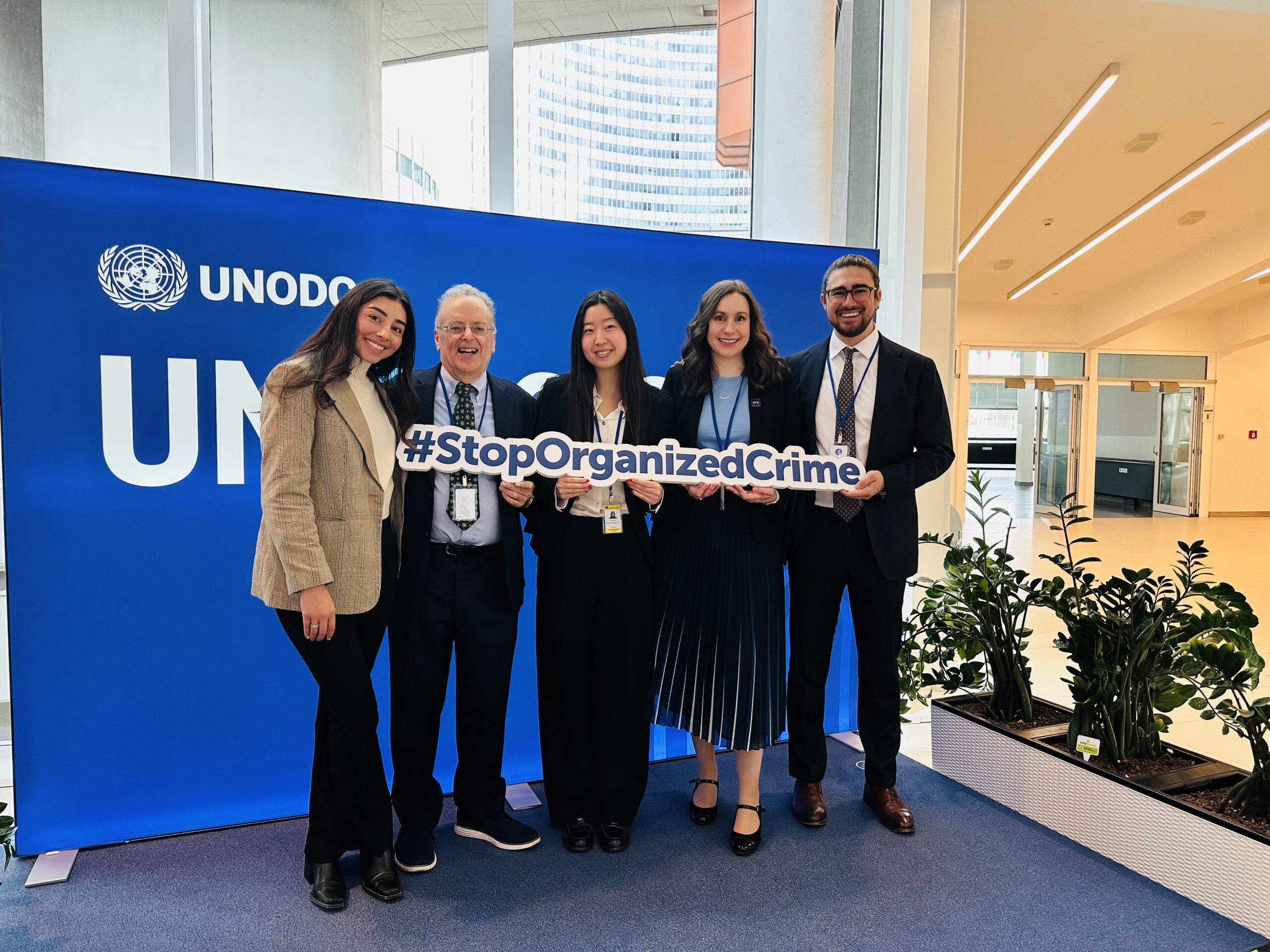
The National Whistleblower Center (NWC) advanced their global education initiative when delegates traveled to the Vienna International Centre in Austria for the Thirteenth Session of the Conference of the Parties to the United Nations Convention against Transnational Organized Crime (UNTOC COP).
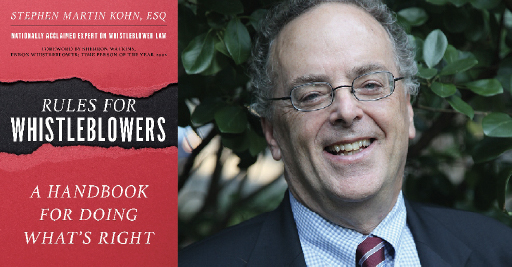
While attending UNTOC COP, NWC Chairman Stephen M. Kohn, Program Manager Jeana Lee and Kohn, Kohn & Colapinto LLP Associate Benjamin Calitri, met with government officials from around the world to share best practice whistleblower policies.
Additionally, NWC hosted a side event, “Effective Practices for International Cooperation on Anti-Money Laundering and Illegal Offshore Banking,” to demonstrate the success of transnational whistleblower laws and encourage countries to consider their own whistleblower rewards programs. In this Sunday Read, we’ll review the delegation’s takeaways from the conference and its sessions.
UNTOC’s Role in Combating Organized Crime
UNTOC is the world’s only global, legally binding instrument through which governments commit to act and cooperate against organized crime. States’ Parties meet every two years at the COP to increase their capacity to combat organized crime, review the implementation of UNTOC and its protocols, and set the anti-crime agenda.
Lee and Calitri delivered remarks at the plenary session, addressing leaders from countries around the world, many of which lack whistleblower reward programs. Lee highlighted the success of U.S. whistleblower reward programs in recovering billions of dollars and explained why other countries should establish their own incentive programs to compensate whistleblowers for reporting crimes.
“Around the world, tips from whistleblowers — as opposed to government investigations and internal audits — are the leading source for uncovering wrongdoing,” Lee said. “Insiders are in the best position to discover and accurately report crime. But there must be incentives and guaranteed protections for these insiders to be willing to take the risk.”
Calitri echoed Lee’s sentiments and further explained how financial crime permeates transnational commerce and how whistleblower incentives can help combat it.
“Whistleblower rewards have been proven to be the most powerful tool to combat and prosecute transnational financial crime,” Calitri said. “Crime is rational. If the benefits of the crime outweigh the risk of detection and the potential punishment, crime will occur. This is especially true for financial crime. Rewards flip this calculus of crime.”
‘International Cooperation’ and Taking Initiative
On October 21, NWC hosted the side event, “Effective Practices for International Cooperation on Anti-Money Laundering and Illegal Offshore Banking.” State delegates and civil society members from around the world attended the morning session.
The session explored ways to improve the detection and deterrence of transnational financial crime, including money laundering and illegal offshore banking. It also examined how anti-corruption advocates can promote formal cooperation and incentivize whistleblowers to report such activity.
Kohn and Lee led the session along with Royal United Services Institute (RUSI) researcher Eliza Lockhart. Lockhart is widely recognized as one of the UK’s top whistleblower law experts. She is the author of the influential report, The Inside Track, The Role of Financial Rewards for Whistleblowers in the Fight Against Economic Crime, which directly informed UK policy discussions and provided critical evidence for the effectiveness of whistleblower rewards programs.
To illustrate the international impact of whistleblowing, Lockhart highlighted major financial scandals and the billions in recovery associated with them. She emphasized that the discovery of these crimes and the ensuing prosecutions wouldn’t have been possible if it weren’t for whistleblowers.
“Whistleblowing historically has been seen as something that should be done out of a desire to do the right thing – a moralistic, altruistic act of an individual,” said Lockhart, who also participated in an NWC webinar on the new UK rewards program in early 2026. “That is very much how whistleblowers view themselves: they are trying to do the right thing. But doing the right thing very often is not enough. Whistleblowers need to be protected, and in the context of our conversation, they often need to receive a financial benefit for what they are about to do, which is potentially destroy their lives and the lives of their loved ones.”
Lockhart added that cultural attitudes toward whistleblower incentives are shifting now that governments and the public in the UK and Australia, for example, are seeing the results.
“When I spoke to UK and Australian regulators, there was still very much … a cultural attitude that paying a whistleblower was just something that just wasn’t done,” she said. “Since then, there have been so many financial scandals that have been broken by whistleblowers. And whistleblowers have felt more comfortable speaking openly about their experiences. I genuinely think public perception has changed a great deal in a lot of these countries. They have seen the suffering that a lot of whistleblowers have gone through. They’ve seen the benefits that have come from their information and they think … it makes sense that they [be] financially rewarded for what they have done.”
Many countries look to U.S. anti-corruption enforcement, such as the Foreign Corrupt Practices Act (FCPA), and the whistleblower incentives associated with it as models. Kohn said international cooperation helped return $17 billion to other countries between 2016 and 2024
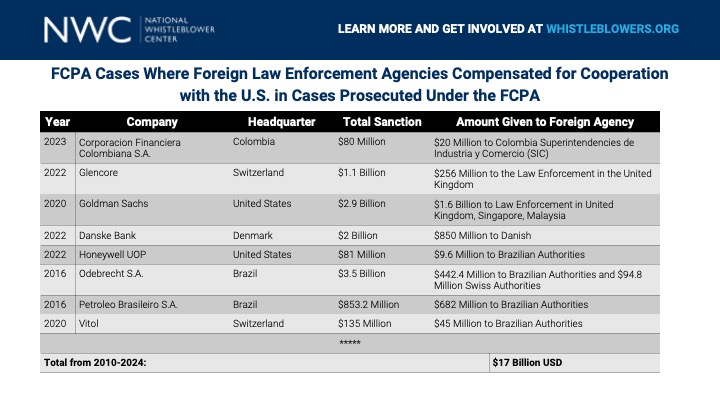
The momentum stalled, Kohn noted, in early 2025 when the Trump administration issued an executive order pausing FCPA enforcement. Kohn expressed his dismay at this development and what he described as a steep decline in FCPA enforcement and international anti-corruption efforts. He did, however, offer attendees a strategy to avoid dependence on U.S. laws. He urged lawyers and NGOs in attendance to form coalitions and lobby governmental decisionmakers and the United Nations to review the data and the recovery amounts for countries outside the U.S. He argued that attendees’ countries could use the FCPA as a template to build a stronger international anti-corruption enforcement system.
“Within two years,” Kohn said, “the system can be recreated three times more powerful than it was, if countries decide to do what they need to do – if they actually believe in anti-corruption, and it’s not a check-the-box rhetoric on one side and cash in the pocket on the other.
“Because the U.S. foreign bribery scheme had one limitation: You needed some form of jurisdiction in the U.S. Given a broad interpretation of transnational crime, we were able to get broad jurisdiction. But I can tell you right now, in doing the cases and studying the prosecutions: If the UK united with just one or two other countries like France, Spain or Switzerland, they could double the jurisdiction, double the penalties.”
Due to the messaging coming from the White House, Kohn stressed that reliance on U.S. investigations and enforcement is not feasible for the foreseeable future.
“You can’t have anti-corruption laws in one country,” Kohn said. “You need a united front.”