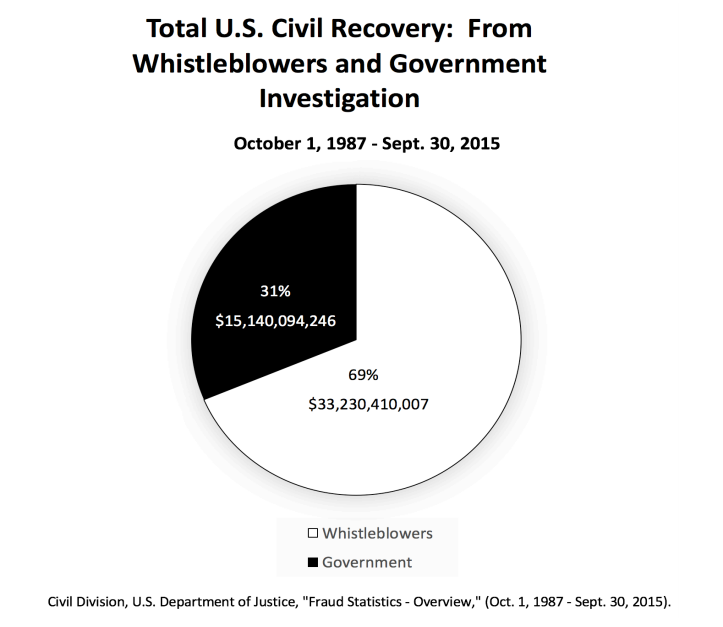
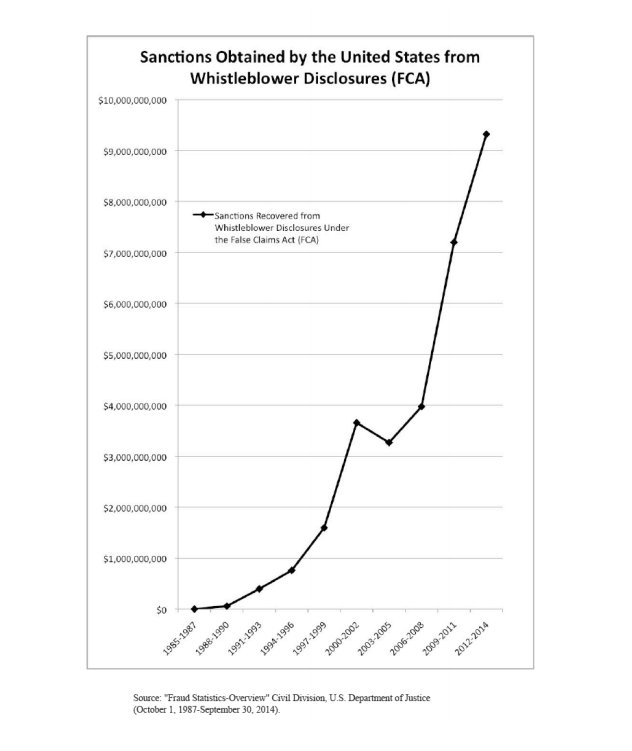
[T]here is no evidence that having stronger monetary incentives to blow the whistle
leads to more frivolous suits.”
Is there a reward law similar to the Lacey Act that has been successfully used?
Yes, the reward provision in the Act to Prevent Pollution from Ships (APPS) is very similar to
the Lacey Act reward provision and has been crucial to enforcement. APPS governs the illegal dumping of oil on the high seas in violation of the MARPOL Convention. Both the wildlife protection laws and APPS cover violations of international conventions that occur outside the United States. The Department of Justice has explained that the reward program “serves a valuable law enforcement purpose by encouraging those most likely to know of the illegal conduct to report it and cooperate with law enforcement, ” and has made the United States the leading country in enforcing MARPOL. Over 50% of prosecutions under APPS rely on whistleblowers.
However, the APPS whistleblower provision is weaker than the wildlife whistleblower laws. Under APPS, the Justice Department must ask a court to approve whistleblower rewards, and the rewards are capped at 50% of any collected penalty. The wildlife laws have no such cap and do not require the government to file a separate motion.
Why is the APPS whistleblower award provision necessary?
In the words of the Department of Justice:
“The APPS whistleblower award provision serves a valuable law enforcement purpose. Violations of the kind seen in this action are exceedingly difficult to detect. They
typically occur far offshore beyond monitoring by the Coast Guard. Illegal dumping is
easy to conceal…The only way such offenses are likely to come to the attention of the
Coast Guard is where low ranking crew members with knowledge step forward.”
“Unfortunately, crew members seldom step forward because providing incriminating
information against senior officers is fraught with peril. While at sea, crew members are
vulnerable to physical harm and other abuses. At the conclusion of a voyage, crew
members risk being fired and subsequently blacklisted from future employment on other
vessels….”
“A monetary award under APPS serves several important functions. It rewards crew
members for taking the personal and professional risks associated with coming forward
and providing information. With respect to future offenses, it provides an incentive to
crew members to alert inspectors and investigators to crimes. Finally, it provides some
measure of compensation when crew members are financially harmed as a result of their
cooperation.”
Is paying rewards consistent with the current mandate from Congress?
Yes. As Congress recently reiterated in enacting the Eliminate, Neutralize and Disrupt (END)
Wildlife Trafficking Act of 2016, “it is the policy of the United States to take immediate actions
to stop the illegal global trade in wildlife and wildlife products and associated transnational
organized crime.” 16 U.S.C. § 7612(1). The statutory language builds on the policies set forth in
Executive Order No. 13648, which established the Presidential Taskforce on Wildlife
Trafficking.
The reward provisions in the Fish and Wildlife Improvement Act provide the perfect tool to
accomplish the policy goals set forth in the END Wildlife Trafficking Act. Congress explained
that one of the purposes of the END Act was to “support the efforts of, and collaborate with,
individuals, communities, local organizations and foreign governments to combat poaching and wildlife trafficking.” 16 U.S.C. § 7611(5). Because many of the violations that comprise wildlife trafficking offenses originate in foreign commerce or are extraterritorial in inception,
international whistleblowers cannot take advantage of many of the protections granted to
United States citizens under other U.S. laws. Rewarding whistleblowers who report wildlife
trafficking violations that could result in a successful prosecution if jurisdiction was ultimately
established under U.S. law is key to promoting the detection of wildlife crimes.
Has the U.S. paid rewards to non-U.S. citizens?
Yes! Foreign sources have been an invaluable asset to the United States. All federal agencies
that implement laws for which the violations can originate overseas actively solicit and support foreign whistleblowers.
The Securities and Exchange Commission (SEC) ’s Office of the Whistleblower has noted,
“allowing foreign nationals to receive awards under the program best effectuates the clear
Congressional purpose underlying the award program.” In FY 2020 , the SEC received whistleblower tips from individuals from 78 different countries.
Will paying rewards interfere with or detract from funds for conservation?
Absolutely not. Paying rewards will incentivize reporting, which in turn will allow the
government to prosecute more crimes, resulting in increased criminal penalties and thus more money for direct conservation. This cycle is exemplified in Act to Prevent Pollution from Ships (APPS) prosecutions . The total amount collected from successful prosecutions is substantially higher than the reward paid to the whistleblower (without whom there often would be no case). Specifically, the whistleblower reward is only based on monies obtained for the APPS violation. Most APPS cases also include convictions based on laws for which rewards are not included, such as obstruction of justice or violations of the Clean Water Act.
In the 70 most recent APPS cases in the public record for which a whistleblower was
responsible for detecting the violation and triggering the successful investigation, the plea
agreements/judgments entered by the courts have directed $45 million to environmental and
conservation organizations, returned $100 million to the U.S. Treasury, and awarded whistleblowers $31.8 million. The whistleblower’s share of the collected proceeds was the
smallest portion of the required payments. Far more important then the sanctions obtained, the whistleblower disclosures were able to hold wrongdoers accountable, force companies to enter into aggressive compliance agreements to prevent future pollution and act as a deterrent on other ship owners.
What is the difference between a tip line and a reward program?
Reward programs and tip lines are completely different. Information through a tip line does not guarantee confidentiality or protection against retaliation. Tip lines generally do not qualify whistleblowers for monetary rewards. Providing information through an established whistleblower program provides whistleblowers with the strongest legal framework. Most whistleblower programs have specific rules for qualifying for a reward maintaining complete confidentiality and protection against retaliation. Currently, the best reward programs are qui tam/False Claims act , SEC Whistleblower rewards , IRS Whistleblower Reward , Commodities Exchange Act , Foreign Corrupt Practices Act
It is well documented that monetary incentives motivate those with information to come forward. “One of the critical challenges facing both [Enforcement and Compliance] officers and government enforcement officials is convincing employees to step forward when misconduct occurs.” Without such an incentive, those with information are unlikely to put their jobs and safety at risk and call a tip line.
Further, employees who report wrongdoing under a reward law are incentivized to provide detailed and high-quality evidence and are further incentivized to work closely with law enforcement on an ongoing basis in order to help ensure that there is a successful prosecution. The whistleblower is rewarded based on the quality of his or her information, and the ability of the United States to obtain credible and admissible evidence as a result of their cooperation.
This has led officials who work with whistleblowers under these programs to comment as to the high quality of information provided under whistleblower reward programs:
- “The Securities and Exchange Commission’s whistleblower program . . . has resulted in investigative staff receiving a substantial volume of high-quality information. It has allowed our investigative staff to work more efficiently and permit permitted us to better utilize agency resources.”
- “[T]he [Securities and Exchange Commission]’s whistleblower program . . . has rapidly become a tremendously effective force-multiplier, generating high-quality tips and, in some cases, virtual blueprints laying out an entire enterprise, directing us to the heart of alleged
fraud.”
Is there legislative support for reward laws?
Yes, whistleblower reward laws enjoy strong bipartisan support. Senator Charles Grassley, the Chairman of the Senate Judiciary Committee, was the author of the 1986 False Claims Act
amendments that created the modern whistleblower reward programs and is the Chair of the Senate Whistleblower Protection Caucus , which has strong bi-partisan membership. In 2016,
Senator Grassley and the Vice Chair of the Whistleblower Caucus, Senator Wyden introduced
Senate Resolution 522, National Whistleblower Appreciation Day. It was unanimously
approved by the Senate.
In a recent hearing before the House Government Oversight Committee on the use of fees and fines collected by the federal government, all Members of the Committee (Democrat and
Republican) praised whistleblowers and the positive impact that Congressionally approved
reward laws have on detection, oversight, and accountability.
“I can assure you that whistleblowers are a vital part of what we do from an oversight
standpoint…”
–Chairman Mark Meadows (R-NC)
“Mr. Kohn, I want you to rest assured. I’ve read your testimony and I actually called my
chief of staff and told him that we needed to make sure that whistleblowers are
compensated and protected.”
–Rep. Gary Palmer (R-AL), the principle sponsor of the fee-related bill under
consideration
How can I get help?
If you need help finding an attorney, visit Resources for Locating an Attorney.
For additional information on the Wildlife Whistleblower Laws, please read Rules 6, 9, and 12 and Checklist 8 published in The New Whistleblower’s Handbook: A Step-by-Step Guide to Doing What’s Right and Protecting Yourself (Lyons Press, 2017).