The National Whistleblower Center (NWC) recently detailed why the Financial Crimes Enforcement Network (FinCEN)’s approach to confidentiality is a major red flag in its proposed whistleblower rules.
As previously noted, FinCEN’s whistleblower rulemaking is not just a confidentiality or domestic compliance issue. It is an international test of whether this United States agency is prepared to build a whistleblower program that can actually reach the global financial networks where money laundering, sanctions evasion, and corruption often begin.
This Sunday Read installment will discuss why public comment – due on June 1 – can help address and correct FinCEN’s shortsightedness during a time when the international community still looks to the U.S. for leadership in the whistleblower landscape.
Recent Developments
On March 30, 2026, FinCEN published a proposed rule in the Federal Register to establish a whistleblower program designed to encourage and incentivize submissions regarding fraud-related violations of the Bank Secrecy Act, U.S. sanctions, and the Anti-Money Laundering Act (AML). The issuance of these proposed regulations follows more than five years after the enactment of the statutory provision creating the whistleblower program. It sets forth the procedures and reward criteria intended to facilitate confidential reporting and enforcement of the covered laws.
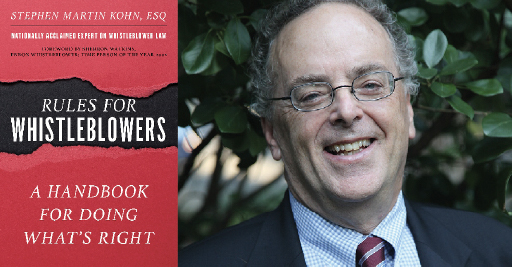
NWC Founder and Chairman of the Board and Kohn, Kohn & Colapinto Founding Partner Stephen Kohn submitted a detailed 19-section legal analysis critiquing FinCEN’s proposal (via regulations.gov) on April 30, 2026. Core failures that define the proposed rules are:
· Procedural traps that punish whistleblowers for reporting in the “wrong order”
· International whistleblowers are left completely exposed
· Non-statutory exclusions congress never authorized
· Oversights in confidentiality rights
“Money laundering networks, sanction evasion schemes, and transnational corruption operations are adaptive,” Kohn noted. “They exploit weak points in law, weak points in enforcement, and weak points in international coordination. A well-designed whistleblower program can help break those networks from the inside. A poorly designed one can leave the networks intact while filtering out the people who know how they work.”
The Critical International Perspective
Kohn and the NWC argued that the proposed rules must be assessed through a global lens, because the people most likely to have the best information are often not operating in the U.S., not protected by U.S. retaliation law, and not operating in a legal environment that makes reporting safe or simple.
“That international dimension changes everything,” Kohn said. “In a purely domestic whistleblower program, regulators can assume a level of legal access, employment protection, and procedural familiarity. AML and sanctions cases do not follow those boundaries. They move across borders – through shell companies, foreign subsidiaries, offshore banks, nominee directors, and intermediaries designed to obscure ownership and responsibility.”
Furthermore, he added, whistleblowers privy to that structure from the inside are often located in countries without effective anti-retaliation laws. Particularly in authoritarian contexts, a whistleblower’s own government may allow employers to threaten and retaliate against whistleblowers with no protection. Some governments may even do the retaliating themselves. Kohn’s comments to FinCEN name many whistleblowers worldwide who reported misconduct through the channels available to them and were fired, jailed, or even killed in retaliation.
That is why confidentiality is so central to the international question. If the proposed rules do not protect identity, source material, and reporting channels with enough care, they risk excluding and endangering the very whistleblowers Congress intended to encourage and support.
Addressing the Non-Linear Path
The rules also need to reflect the fact that international whistleblowers rarely come forward in a neat, linear way. They may begin by telling a supervisor, a local regulator, a foreign enforcement agency, a nongovernmental organization, a journalist, or a U.S. embassy official.
That is not a sign of unreliability, Kohn noted, but often the only realistic path available.
“In many countries, a whistleblower may not even know whether U.S. law applies when they first speak,” he said. “They are often acting on instinct, urgency, and personal risk rather than legal strategy. This is where FinCEN’s proposed framework can easily become too narrow. If the final rule treats only one kind of first disclosure as ‘real’ or ‘voluntary,’ it will overlook how international whistleblowing actually works.”
NWC argues that the rule should recognize the wide range of channels through which transnational information is commonly reported. This includes disclosures made outside the U.S. and to non-governmental, because in AML cases the first safe contact is often not the most formal one. While the AML WIA is written to support these third-party reporters, FinCEN’s current proposal falls short. A system that fails to recognize international whistleblowers’ actual reporting behavior will disqualify deserving whistleblowers for reasons that have little to do with the quality or significance of their information.
Critical Influence from International Groups
The Organisation for Economic Co-operation and Development (OECD) was cited heavily in Kohn’s comments. The OECD’s recommendations reinforce the same international lesson: global anti-corruption enforcement depends on clear guidance for whistleblowers, especially where the reporting environment is fragmented or risky. The OECD has recognized that whistleblowers often come forward through multiple channels, including foreign agencies and non-governmental actors. That point is especially relevant to FinCEN because the conduct at issue is inherently cross-border.
“If the U.S. wants useful information from abroad, it cannot insist that everyone report in a single domestic style,” Kohn said. “It is an unreasonable expectation.”
If international whistleblowers conclude that FinCEN’s rules are too restrictive or too unforgiving, the program may fail before it begins. That would have consequences far beyond the whistleblower community – it would drastically decrease the number of international tips U.S. enforcement agencies receive.
FinCEN’s proposal should be judged by whether it can protect a reporter in another country, preserve a claim that begins outside the U.S., and support enforcement in cases that cross borders from the start. If the answer is yes, the AML WIA can become an important tool in global efforts to combat financial crime. If the answer is no, it risks becoming a program that looks strong on paper but fails where the real danger is greatest.
“The next version of the rule should make it clear that whistleblowers outside the United States are not exceptions to the system – they are central to it,” Kohn noted. “If FinCEN wants the program to work, it must be built for the world as it is, not just for the U.S. as regulators might prefer it to be.”
What You Can Do To Strengthen the Proposed FinCEN Rules
NWC has created a guide instructing the public on how to submit a comment to FinCEN critiquing the proposed rules. The public comment period is rapidly approaching its close on June 1. As noted in the guide, a public comment is not a petition – it carries legal force, as FinCEN is legally required to take every comment it receives into consideration when implementing its final rules. Filing your comment with FinCEN is a generational opportunity to weigh in on the most important whistleblower rulemaking in the past 15 years.
The broader public policy argument is straightforward: if the goal of the AML is to unearth sophisticated financial crime, then the rules must reward people who take the risk of speaking up, not create technical barriers that disqualify them after the fact.
This is a historic opportunity to shape policies that expose corruption and reduce waste, fraud and abuse in the U.S. and worldwide.